 Bug FAQ
Indian Jumping Ant
Harpegnathos saltator · Order: Hymenoptera · Family: Formicidae
Also called: Jerdon's Jumping Ant
Source: Wikipedia
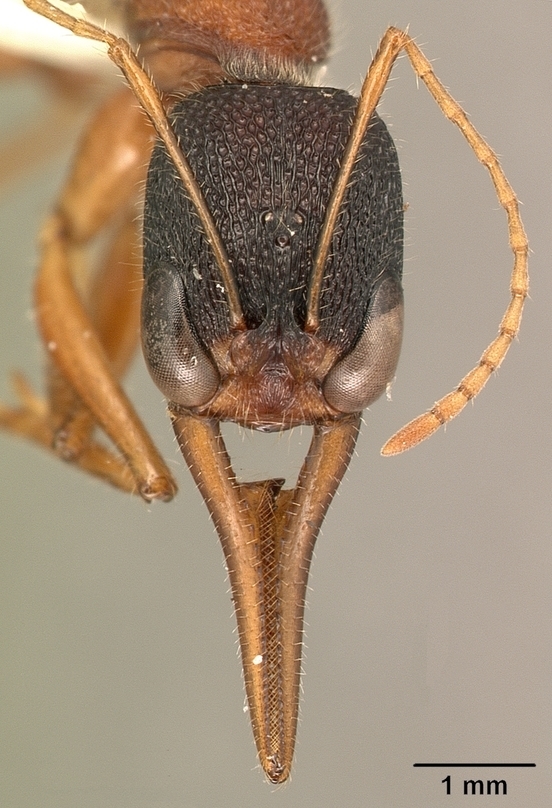
Workers are about three-quarters of an inch long with a long head, blackish-brown body and rufous legs. They hunt live insects in the early morning and are very aggressive, biting and stinging when disturbed.
Source: Wikipedia
How to recognize it
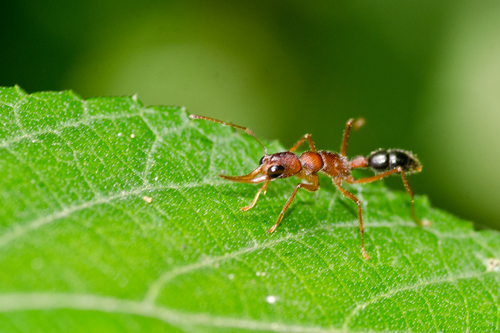
The head, thorax and pedicel are reddish-brown and granulated, while the abdomen is black and shiny; mandibles, antennae and legs are yellow. Overall the insect is covered with short pale hairs and a fine silvery sheen visible in certain light.
Source: Wikipedia
Size
Workers measure about three-quarters of an inch in length. The head is long and granulated, jaws have a strong tooth and are serrated, and the abdomen is very long with a large sting.
Source: Wikipedia
Does it bite or sting?
The ant is very aggressive and can both bite and sting severely.
Source: Wikipedia
Where it lives
Nests are built underground near plant roots, with the entrance marked by a low mound surrounded by twigs and leaves.
Source: Wikipedia
What it eats
They prey on live insects, capturing them alive.
Source: Wikipedia
Life cycle
Colonies are small, with few individuals and only slight differences between workers and queens.
Source: Wikipedia
When you see it
Workers forage during cool morning and afternoon hours, pause at midday, and close the nest entrance at night, reopening it in the day.
Source: Wikipedia
Where it comes from
The Indian jumping ant is found in India, including regions such as Tellicherry, Malabar and Mysore.
Source: Wikipedia
More photos
Questions people ask
Where do they build their nests?
They nest underground near plant roots, with a low mound entrance surrounded by twigs and leaves.
Source: Wikipedia
Same family (Formicidae)
 Eastern Black Carpenter AntCamponotus pennsylvanicusCan damage your home
 Red Imported Fire AntSolenopsis invictaCan sting
 American Winter AntPrenolepis imparis
 Argentine AntLinepithema humileNuisance, not dangerous
 Immigrant Pavement AntTetramorium immigransCan sting
 Odorous House AntTapinoma sessileCan damage your home
Sources
- Wikipedia: https://en.wikipedia.org/wiki/Harpegnathos_saltator
Look it up elsewhere: GBIF · iNaturalist · BugGuide · ITIS · Wikipedia
Text written 2026-10-23 from the sources above and checked sentence by sentence against them. Data fetched 2026-10-23.