 Bug FAQ
Hornet Mimic Hover Fly
Volucella zonaria · Order: Diptera · Family: Syrphidae
Also called: Hornet Hoverfly, Hornet Mimic Hoverfly
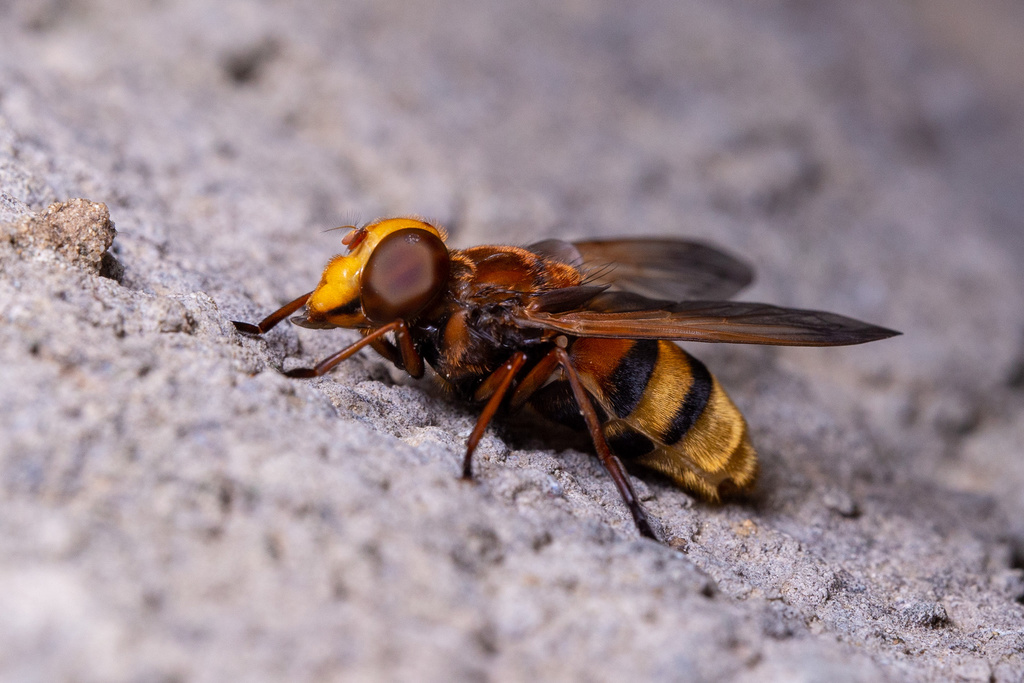
The hornet-mimic hoverfly can grow up to 25 mm long with a wingspan of about 40 mm and has a reddish-brown thorax, a reddish-yellow abdomen with two black bands, and amber-tinged wings. Adults are found from May to September, especially in July and August, in meadow habitats near forests across most of Europe and parts of Asia, and they feed on nectar from many flowering plants.
Source: Wikipedia
How to recognize it
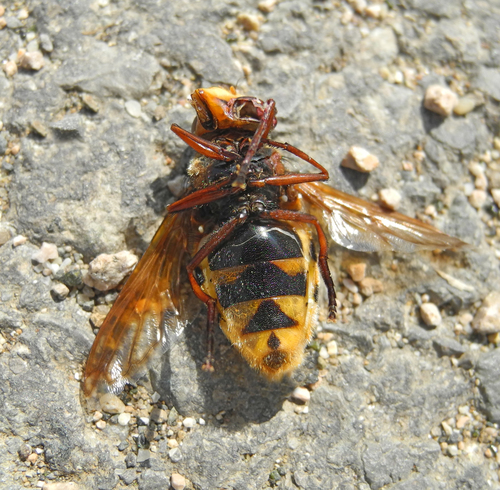
It has a shiny reddish-brown thorax with dark marks, a reddish-brown scutellum, and a reddish-yellow abdomen marked by two wide black bands; the underside shows broad black bars and the first abdominal segment is black.
Source: Wikipedia
Size
Length can reach 25 mm and wingspan about 40 mm.
Source: Wikipedia
Where it lives
Usually found in meadows close to forests.
Source: Wikipedia
What it eats
Adults feed on nectar from many flowers such as valerian, oregano, mint, scabious, dogwood, privet, thistles, buddleia and other shrubs.
Source: Wikipedia
Life cycle
Pupae overwinter in soil and emerge in spring. Adults are migratory; this species migrates in the Mediterranean region.
Source: Wikipedia
When you see it
Adults are on the wing from May to September, most common in July and August.
Source: Wikipedia
Where it comes from
Present in most of Europe, Tunisia, Iran, Russia to the Far East, and Mongolia.
Source: Wikipedia
Lookalikes
It mimics the European hornet by size, coloration and buzzing flight.
Source: Wikipedia
More photos
Questions people ask
Why does it look like a hornet?
The species mimics the European hornet in size and appearance as a defensive strategy.
Source: Wikipedia
Same family (Syrphidae)


Sources
- Wikipedia: https://en.wikipedia.org/wiki/Volucella_zonaria
Look it up elsewhere: GBIF · iNaturalist · BugGuide · Wikipedia
Text written 2026-10-22 from the sources above and checked sentence by sentence against them. Data fetched 2026-10-22.