 Bug FAQ
Holhymenia histrio
Holhymenia histrio · Order: Hemiptera · Family: Coreidae
Source: Wikipedia
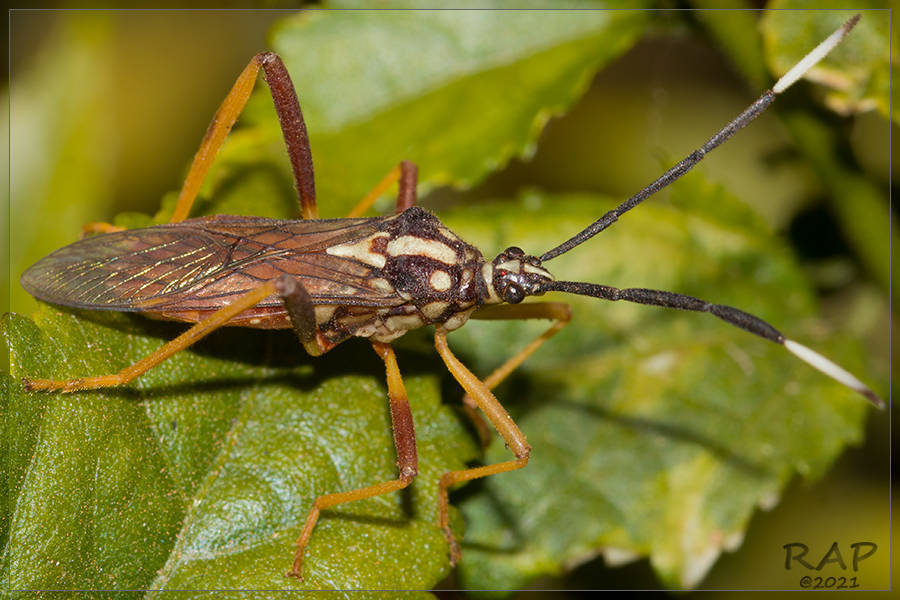
Adults feed on Passiflora species and can cause visible damage to foliage, stems and fruit. They do not bite or sting people.
Source: Wikipedia
How to recognize it
Adults have black heads, a thorax with pale yellow spots, and a dark brown abdomen marked with black spots and bands; the forelegs are solid yellow, hind-leg femurs are auburn brown and the tibiae and tarsi are yellow.
Source: Wikipedia
Is it a pest in the house?
Because of their feeding habits they are considered pests.
Source: Wikipedia
Where it lives
They are most common in South America, especially Argentina and Brazil, and are often found in heavily farmed areas.
Source: Wikipedia
What it eats
They feed on plants of the Passiflora genus, extracting fluids from leaves, stems and fruits.
Source: Wikipedia
Life cycle
Eggs are dark brown and oval-shaped. Nymphs look like smaller adults but lack functional wings until they mature.
Source: Wikipedia
Lookalikes
Adults mimic the coloration and shape of ichneumonid wasps, an example of Batesian mimicry.
Source: Wikipedia
More photos
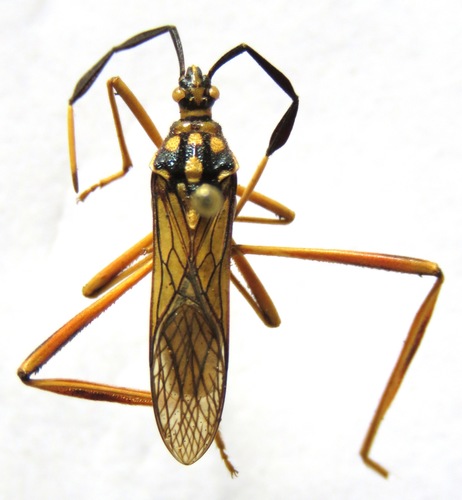
Questions people ask
What plants does Holhymenia histrio damage?
It feeds on passion-fruit (Passiflora) plants, damaging leaves, stems and fruits.
Source: Wikipedia
Where is this bug found?
It occurs throughout Mexico and South America, especially in Argentina and Brazil, often in agricultural areas.
Source: Wikipedia
Why does it look like a wasp?
The adult mimics ichneumonid wasps in color and shape, a form of Batesian mimicry.
Source: Wikipedia
Same family (Coreidae)
 Western Conifer Seed BugLeptoglossus occidentalisDamages trees, gardens or crops
 Squash BugAnasa tristisDamages trees, gardens or crops
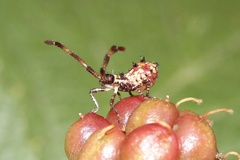 Dock BugCoreus marginatus
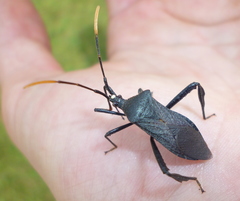 Acanthocephala terminalisAcanthocephala terminalisHarmless
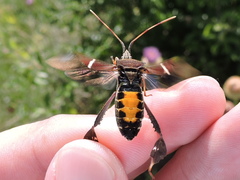 Eastern Leaf-footed BugLeptoglossus phyllopusDamages trees, gardens or crops
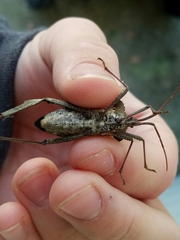 Giant leaf-footed bugAcanthocephala declivis
Sources
- Wikipedia: https://en.wikipedia.org/wiki/Holhymenia_histrio
Look it up elsewhere: GBIF · iNaturalist · BugGuide · ITIS · Wikipedia
Text written 2026-10-23 from the sources above and checked sentence by sentence against them. Data fetched 2026-10-22.