 Bug FAQ
High Noon Ant
Forelius pruinosus · Order: Hymenoptera · Family: Formicidae
Source: Wikipedia

High noon ants are small ants that feed on nectar, insects and tend hemipteran insects. They nest inside homes on the Gulf Coast and are most active in hot weather, with winged reproductives appearing from May to August.
Source: Wikipedia
How to recognize it
They have mutualistic relationships with various insects and plants while feeding on nectar and small invertebrates.
Source: Wikipedia
Is it a pest in the house?
They are considered a household pest in the Gulf Coast, nesting inside homes and invading houses.
Source: Wikipedia
Where it lives
On the Gulf Coast they commonly nest inside houses and invade indoor spaces.
Source: Wikipedia
What it eats
They mainly eat flower nectar and small invertebrates, and they tend hemipteran insects for honeydew.
Source: Wikipedia
Life cycle
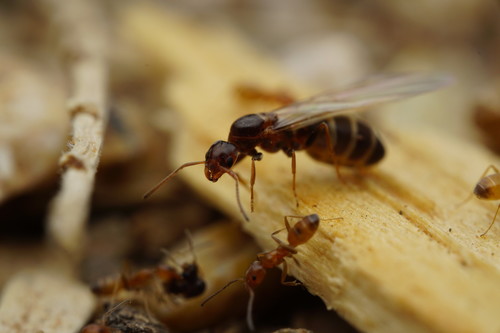
Winged reproductive ants (alates) are observed from May through August, and colonies have multiple queens.
Source: Wikipedia
When you see it
The ants are most active during hot periods of the year.
Source: Wikipedia
Where it comes from
The species is native to North America, found in the United States, Cuba and Mexico, and has recently been seen in Latin America.
Source: Wikipedia
Where it is found in the US
Recorded in 37 of 51 states and DC. Most records: Texas, Florida, New Mexico, Arizona, Georgia, Mississippi, Utah, California.
Darker = more records. Counts are museum and citizen-science records, not population size.
Source: GBIF
Status: native in North America; native in Canada; native in United States. Source: iNaturalist
Months it is reported in the US
Source: GBIF
More photos
Questions people ask
When are high noon ants most active?
They are most active in hot weather, and winged reproductives appear from May to August.
Source: Wikipedia
Same family (Formicidae)
 Eastern Black Carpenter AntCamponotus pennsylvanicusCan damage your home
 Red Imported Fire AntSolenopsis invictaCan sting
 American Winter AntPrenolepis imparis
 Argentine AntLinepithema humileNuisance, not dangerous
 Immigrant Pavement AntTetramorium immigransCan sting
 Odorous House AntTapinoma sessileCan damage your home
Sources
- Wikipedia: https://en.wikipedia.org/wiki/Forelius_pruinosus
Look it up elsewhere: GBIF · iNaturalist · BugGuide · ITIS · Wikipedia
Text written 2026-10-23 from the sources above and checked sentence by sentence against them. Data fetched 2026-10-23.