 Bug FAQ
Helastia corcularia
Helastia corcularia · Order: Lepidoptera · Family: Geometridae
Source: Wikipedia

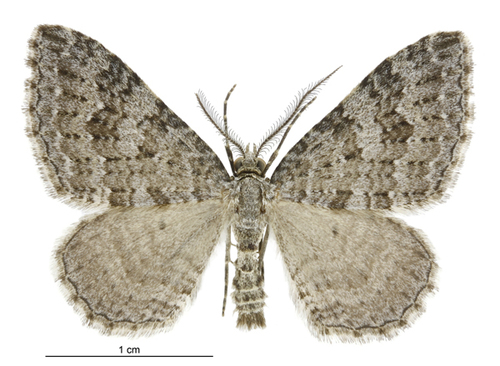
Helastia corcularia is a small moth with beak-like palps and finely pectinate antennae in males; females have thread-like antennae. It lives in many New Zealand habitats such as native forest, scrub, gardens, parks, coastal areas and sub-alpine herbfields, and adults fly from September to May, attracted to light at night.
Source: Wikipedia
How to recognize it
The wings show denticulated lines, darker median areas, fine white dots near the elbow and subterminal region, and a lightly wavy blackish fringe; the underside is whitish-grey with similar punctiform lines.
Source: Wikipedia
Size
It is smaller than the related species salicata but similar in colour.
Source: Wikipedia
Is it a pest in the house?
It is regarded as a contaminant in orchards and fruit pack houses.
Source: Wikipedia
Where it lives
It inhabits native forest, scrubland, gardens, parks, coastal zones and sub-alpine herbfields.
Source: Wikipedia
What it eats
Larvae feed on herbs, lichens and moss.
Source: Wikipedia
Life cycle
Adults are on the wing from September to May, are nocturnal and are attracted to light.
Source: Wikipedia
When you see it
Adults are active from September through May.
Source: Wikipedia
Where it comes from
The moth is endemic to New Zealand, found throughout the South Island and the Chatham Islands.
Source: Wikipedia
Lookalikes
It can be told apart from H. semisignata, which is slightly smaller and occurs only in the North Island.
Source: Wikipedia
More photos

Questions people ask
How can I tell Helastia corcularia apart from similar moths?
Look for its slightly larger size and the distinctive denticulated wing lines with fine white dots; the male’s antennae are long and pectinate, while the female’s are thread-like.
Source: Wikipedia
When are adult Helastia corcularia active?
Adults fly from September through May and are attracted to lights at night.
Source: Wikipedia
What do the larvae of Helastia corcularia eat?
The larvae feed on herbs, lichens and moss.
Source: Wikipedia
Same family (Geometridae)
 Willow BeautyPeribatodes rhomboidaria
 Pale BeautyCampaea perlataDamages trees, gardens or crops
 Large Lace-border MothScopula limboundataDamages trees, gardens or crops
 Riband WaveIdaea aversata
 Yellow Shell MothCamptogramma bilineata
 Large Maple Spanworm MothProchoerodes lineolaDamages trees, gardens or crops
Sources
- Wikipedia: https://en.wikipedia.org/wiki/Helastia_corcularia
Look it up elsewhere: GBIF · iNaturalist · BugGuide · Wikipedia
Text written 2026-10-23 from the sources above and checked sentence by sentence against them. Data fetched 2026-10-23.