 Bug FAQ
Hecla Sulphur
Colias hecla · Order: Lepidoptera · Family: Pieridae
Also called: Arctic sulphur, Greenland Sulphur

The Hecla sulphur butterfly has a wingspan of about 36 to 46 mm and lives in moist tundra habitats. It flies from June to August, and its larvae feed on several Arctic plants such as Astragalus species, white clover and Arctic willow. Its range includes northern Europe, Greenland, Alaska and much of northern Canada and the Russian Far East.
Source: Wikipedia
How to recognize it
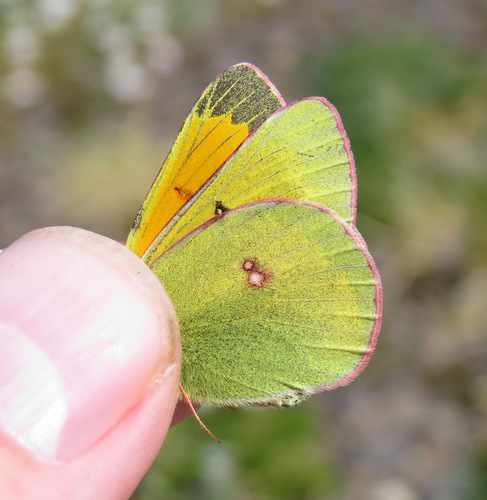
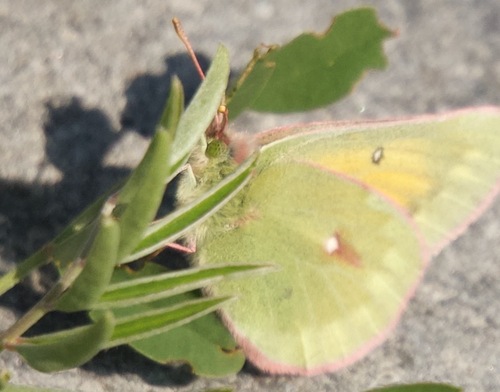
Females have a black wing edge that is broken by many yellow “windows”, unlike the solid black edge of males.
Source: Wikipedia
Size
The wingspan measures between 36 and 46 mm.
Source: Wikipedia
Where it lives
It is found in moist tundra environments.
Source: Wikipedia
What it eats
The caterpillars feed on Astragalus species, including A. frigidus and A. alpinus, white clover (Trifolium repens) and, where Astragalus is absent, Arctic willow (Salix arctica).
Source: Wikipedia
Life cycle
Adults are on the wing from June through August, depending on the location.
Source: Wikipedia
When you see it
The flight period spans June to August, varying with region.
Source: Wikipedia
Where it comes from
In North America it occurs in Alaska and the northern Canadian territories such as the Northwest Territories, Yukon, Quebec, Labrador, Manitoba and the Chukot region. It is also native to northern parts of Norway, Sweden and Finland (up to 900 m), Greenland, eastern Chukotka and the Russian Far East.
Source: Wikipedia
Lookalikes
It was first described from Greenland, where no other Colias species occur, so it has no close look-alikes there.
Source: Wikipedia
Where it is found in the US
Recorded in 3 of 51 states and DC. Most records: Alaska, Washington, Montana.
Darker = more records. Counts are museum and citizen-science records, not population size.
Source: GBIF
Status: native in North America; native in Canada. Source: iNaturalist
Months it is reported in the US
Source: GBIF
More photos
Questions people ask
When can I see the Hecla sulphur butterfly?
Adults fly from June to August, with exact timing depending on where you are.
Source: Wikipedia
Where does the Hecla sulphur live?
It inhabits moist tundra across northern Europe, Greenland, Alaska, northern Canada and the Russian Far East.
Source: Wikipedia
How can I tell a female Hecla sulphur from a male?
Females have a black wing edge broken by many yellow windows, while males have a solid black edge.
Source: Wikipedia
What do the caterpillars eat?
They feed on Astragalus species, white clover and Arctic willow when Astragalus is not present.
Source: Wikipedia
Same family (Pieridae)


Sources
- Wikipedia: https://en.wikipedia.org/wiki/Colias_hecla
Look it up elsewhere: GBIF · iNaturalist · BugGuide · ITIS · Wikipedia
Text written 2026-10-23 from the sources above and checked sentence by sentence against them. Data fetched 2026-10-23.