 Bug FAQ
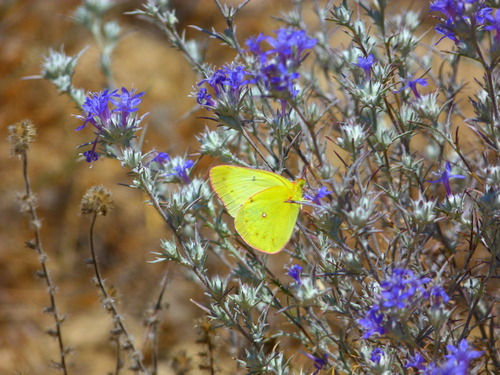
Harford's Sulphur
Colias harfordii · Order: Lepidoptera · Family: Pieridae
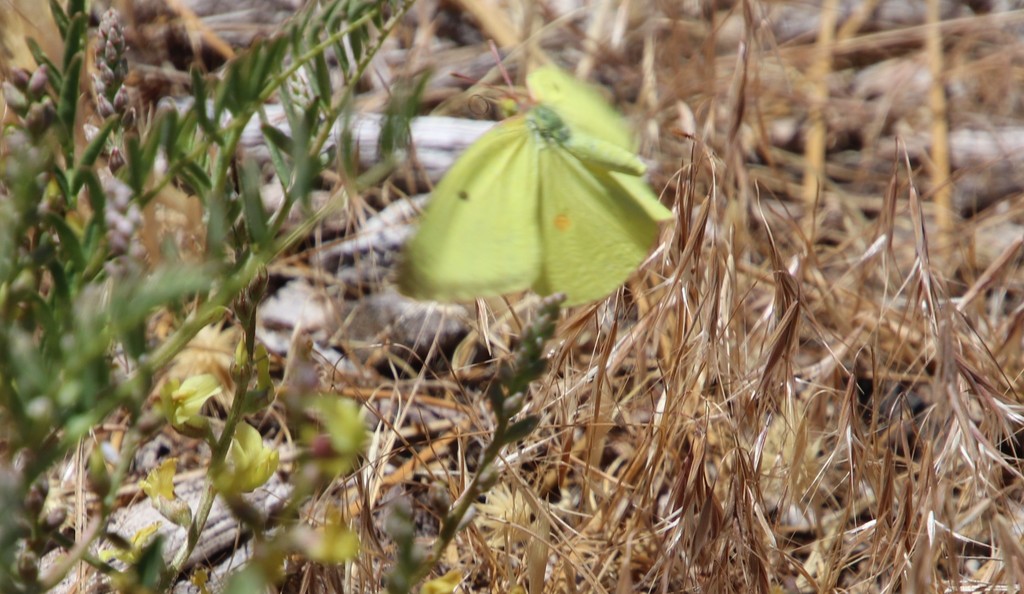
Adults sip nectar from thistles and mints, while the caterpillars eat the leaves of Douglas’ milkvetch (Astragalus douglasii) and overwinter as larvae.
Source: Wikipedia
How to recognize it
Harford's sulphur belongs to the butterfly family Pieridae.
Source: Wikipedia
Size
Its wingspan ranges from 44 to 51 mm, roughly 1.7 to 2.0 inches.
Source: Wikipedia
Where it lives
It prefers open chaparral and clearings within woodlands.
Source: Wikipedia
What it eats
Adult butterflies feed on nectar from thistles and mint flowers. Caterpillars feed on the leaves of the plant Astragalus douglasii.
Source: Wikipedia
Life cycle
The species spends the winter in the larval stage.
Source: Wikipedia
When you see it
Adults are active in two periods: February-May and June-August.
Source: Wikipedia
Where it is found in the US
Recorded in 3 of 51 states and DC. Most records: California, Utah, Washington.
Darker = more records. Counts are museum and citizen-science records, not population size.
Source: GBIF
Months it is reported in the US
Source: GBIF
More photos
Questions people ask
When can I see Harford's sulphur butterflies?
They are on the wing from February through May and again from June through August.
Source: Wikipedia
Where does this butterfly live?
It inhabits open chaparral and woodland clearings in southern California, from Kern County down to San Diego County.
Source: Wikipedia
Same family (Pieridae)



Sources
- Wikipedia: https://en.wikipedia.org/wiki/Colias_harfordii
Look it up elsewhere: GBIF · iNaturalist · BugGuide · ITIS · Wikipedia
Text written 2026-10-24 from the sources above and checked sentence by sentence against them. Data fetched 2026-10-24.