 Bug FAQ
Hairy-eyed Flower Fly
Syrphus torvus · Order: Diptera · Family: Syrphidae

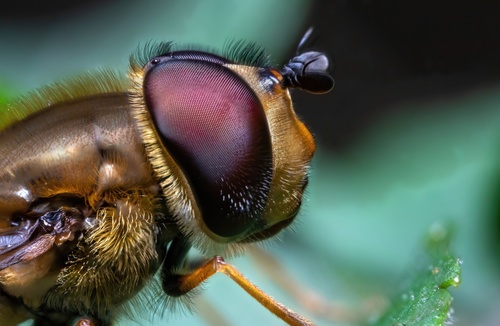
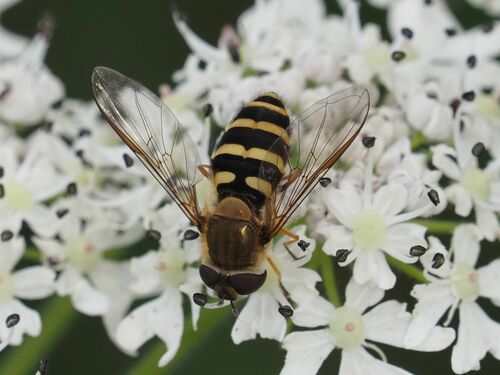
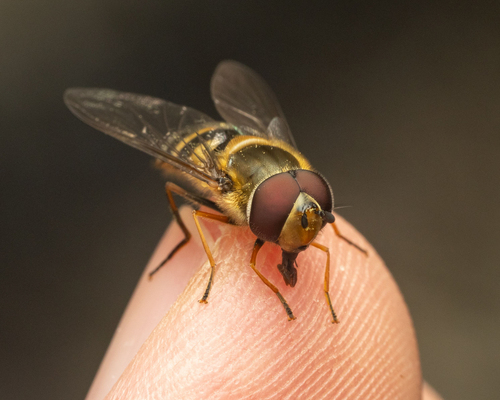
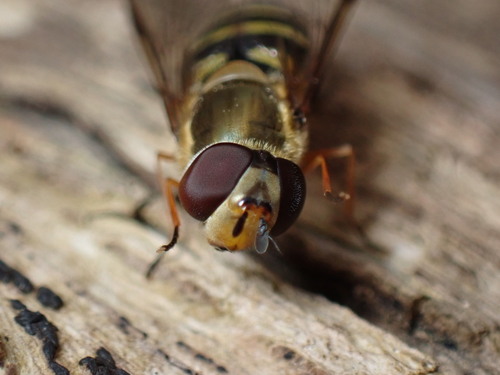
The hairy-eyed flower fly has many hairs on its eyes; males have long dense hairs while females have shorter ones. It lives in conifer and broadleaf forests, dwarf-shrub tundra, and also in suburban gardens and urban parks with mature trees. Adults sip pollen and nectar, and their larvae hunt aphids on trees, bushes and shrubs.
Source: Wikipedia
How to recognize it
Eyes are covered with many hairs; males have long dense hairs, females have shorter hairs. The third femur is black on the basal three-quarters.
Source: Wikipedia
Where it lives
Found in Abies, Picea and Pinus forests, as well as Betula, Fagus and Quercus forests and dwarf-shrub tundra.
Source: Wikipedia
What it eats
Adults feed on pollen and nectar. Larvae feed on aphids found on trees, bushes and shrubs.
Source: Wikipedia
Life cycle
The species overwinters in the larval stage. Adults are on the wing from March through October.
Source: Wikipedia
When you see it
Active flight period spans March to October.
Source: Wikipedia
Where it comes from
Occurs across the Palearctic from Greenland and Fennoscandia to the Mediterranean, through Europe into Siberia, the Russian Far East, Japan, and parts of Indomalaya; in the Nearctic from Alaska to New Mexico.
Source: Wikipedia
Where it is found in the US
Recorded in 37 of 51 states and DC. Most records: Alaska, Washington, Georgia, Massachusetts, Pennsylvania, New York, Illinois, Oregon.
Darker = more records. Counts are museum and citizen-science records, not population size.
Source: GBIF
Status: native in North America; native in Canada. Source: iNaturalist
Months it is reported in the US
Source: GBIF
More photos
Questions people ask
What do the larvae eat?
The larvae prey on aphids that live on trees, bushes and shrubs.
Source: Wikipedia
Where are they most likely to be found?
They inhabit conifer and broadleaf forests, dwarf-shrub tundra, and also suburban gardens and urban parks with mature trees.
Source: Wikipedia
Same family (Syrphidae)


Sources
- Wikipedia: https://en.wikipedia.org/wiki/Syrphus_torvus
Look it up elsewhere: GBIF · iNaturalist · BugGuide · ITIS · Wikipedia
Text written 2026-10-22 from the sources above and checked sentence by sentence against them. Data fetched 2026-10-22.