 Bug FAQ
Hairy Carpenter Ant
Camponotus vagus · Order: Hymenoptera · Family: Formicidae
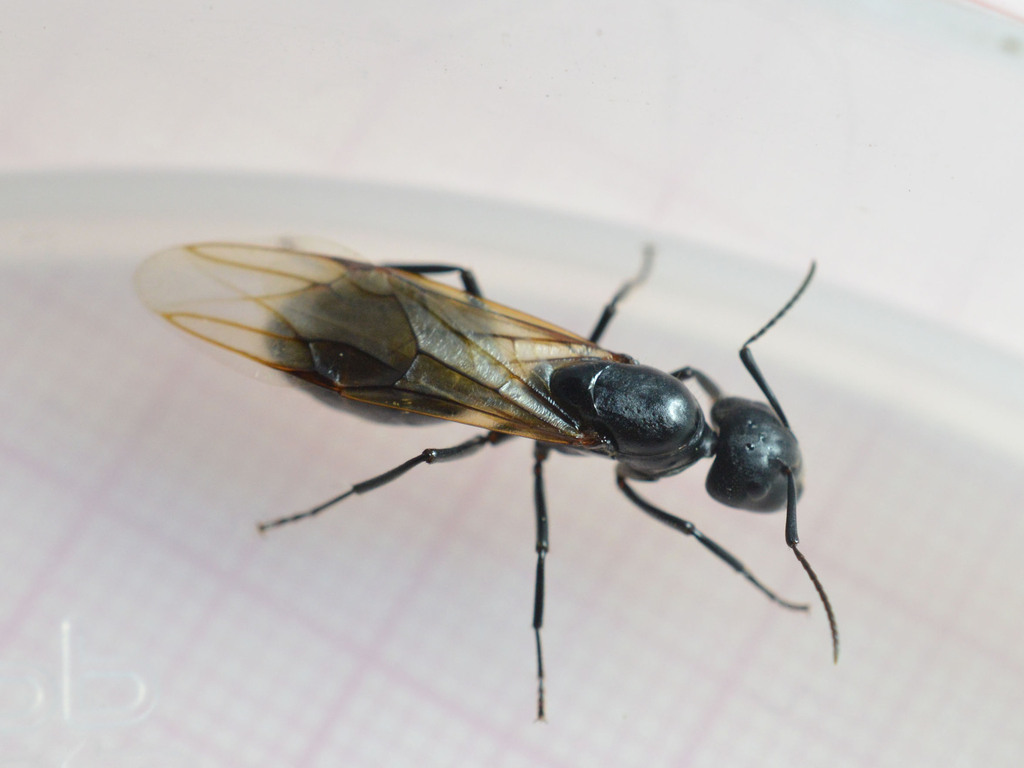
Hairy carpenter ants are large, uniformly black insects covered in dense body hairs. Workers range from 6 to 12 mm, with larger guard ants protecting smaller foragers. Colonies live in dry open forests, building nests in dead wood or under stones, and can number up to 10 000 ants.
Source: Wikipedia
How to recognize it
They are easy to spot by their big size, solid black color, and long, dense hairs on the body.
Source: Wikipedia
Size
Worker ants measure between 6 and 12 mm long. The biggest workers act as guards for the colony.
Source: Wikipedia
Where it lives
They prefer dry habitats such as open forests and forest edges. Nests are usually made in dead wood, but they can also be founded under stones.
Source: Wikipedia
What it eats
They eat both other insects and the sugary honeydew produced by aphids.
Source: Wikipedia
Life cycle
Colonies typically contain 1 000 to 4 000 workers, though some grow to 10 000 ants.
Source: Wikipedia
Where it comes from
Their range covers much of Europe, a large part of Asia, and north-western Africa. They are especially common in central Europe, extending from southern Scandinavia to north-west Africa and from Portugal to Mongolia.
Source: Wikipedia
More photos


Questions people ask
Where are they most likely to be found?
In dry, open forest areas and at forest edges across Europe, Asia, and north-west Africa.
Source: Wikipedia
Same family (Formicidae)
 Eastern Black Carpenter AntCamponotus pennsylvanicusCan damage your home
 Red Imported Fire AntSolenopsis invictaCan sting
 American Winter AntPrenolepis imparis
 Argentine AntLinepithema humileNuisance, not dangerous
 Immigrant Pavement AntTetramorium immigransCan sting
 Odorous House AntTapinoma sessileCan damage your home
Sources
- Wikipedia: https://en.wikipedia.org/wiki/Camponotus_vagus
Look it up elsewhere: GBIF · iNaturalist · BugGuide · ITIS · Wikipedia
Text written 2026-10-22 from the sources above and checked sentence by sentence against them. Data fetched 2026-10-22.