 Bug FAQ
Grey rush case-bearer
Coleophora glaucicolella · Order: Lepidoptera · Family: Coleophoridae
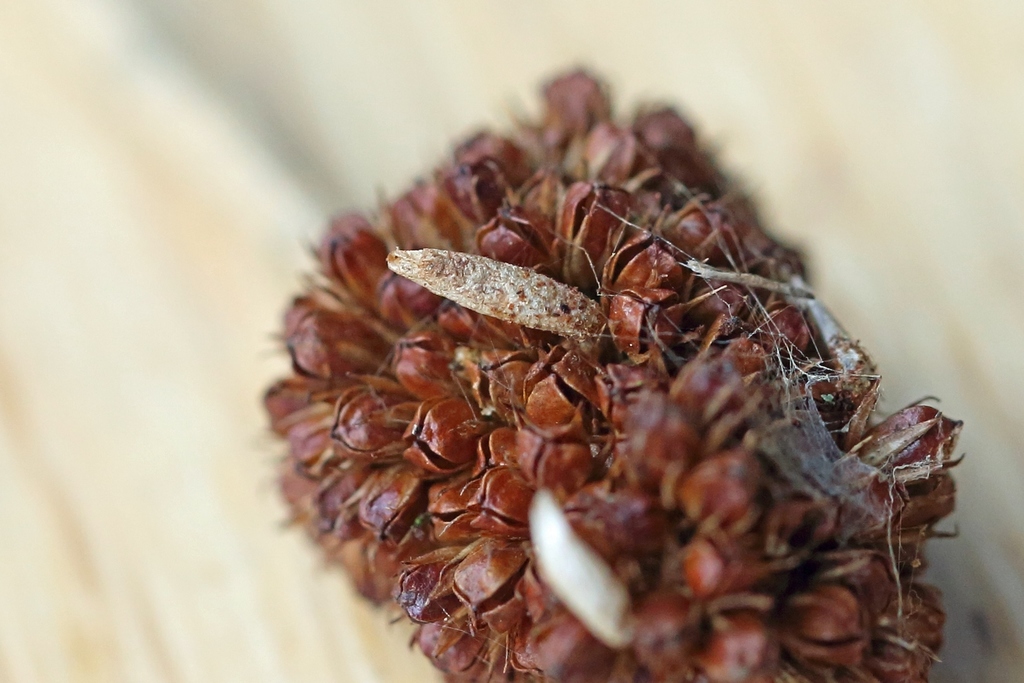
The grey rush case-bearer is a tiny moth with a 10 to 12 mm wingspan and pale, yellow-ochre forewings marked by darker grey streaks between the veins near the costa. Its larvae feed on the seeds of several rush species (Juncus) and possibly on woodrush (Luzula). Adults are on the wing from June to August, flying at sunrise, dusk and night, and the species inhabits forest-steppe, wet meadow and meadow-steppe habitats across Europe, Asia and North America.
Source: Wikipedia
How to recognize it
The forewings are pale, often yellowish-ochre, with darker grey streaks between the veins near the leading edge.
Source: Wikipedia
Size
The wingspan measures about 10 to 12 mm.
Source: Wikipedia
Where it lives
It lives in forest-steppe areas, wet meadows and meadow-steppe habitats.
Source: Wikipedia
What it eats
The caterpillars feed on the seeds of rushes such as Juncus inflexus, J. conglomeratus, J. effusus and J. gerardii, and may also use woodrush (Luzula).
Source: Wikipedia
Life cycle
Adults fly from June through August, being active at sunrise, dusk and at night.
Source: Wikipedia
When you see it
The flight period is June to August, with activity at dawn, dusk and night.
Source: Wikipedia
Where it comes from
In North America it occurs across most of Canada and in Ohio, USA. Its range also includes Europe east to the Urals and Iran, as well as Greenland, China and other parts of Asia.
Source: Wikipedia
Lookalikes
It can only be reliably distinguished from similar moths by dissecting and examining the genitalia under a microscope.
Source: Wikipedia
Where it is found in the US
Recorded in 24 of 51 states and DC. Most records: Maryland, Tennessee, Michigan, Washington, West Virginia, Maine, Virginia, Rhode Island.
Darker = more records. Counts are museum and citizen-science records, not population size.
Source: GBIF
Status: native in North America; native in Canada. Source: iNaturalist
Months it is reported in the US
Source: GBIF
More photos

Questions people ask
When are the adults active?
Adults are on the wing from June to August, flying at sunrise, dusk and night.
Source: Wikipedia
How can I tell this moth apart from similar species?
Only a microscopic examination of the genitalia after dissection can reliably separate it from look-alikes.
Source: Wikipedia
Same family (Coleophoridae)



Sources
- Wikipedia: https://en.wikipedia.org/wiki/Coleophora_glaucicolella
Look it up elsewhere: GBIF · iNaturalist · BugGuide · Wikipedia
Text written 2026-10-27 from the sources above and checked sentence by sentence against them. Data fetched 2026-10-27.