 Bug FAQ
Grey flesh fly
Sarcophaga bullata · Order: Diptera · Family: Sarcophagidae
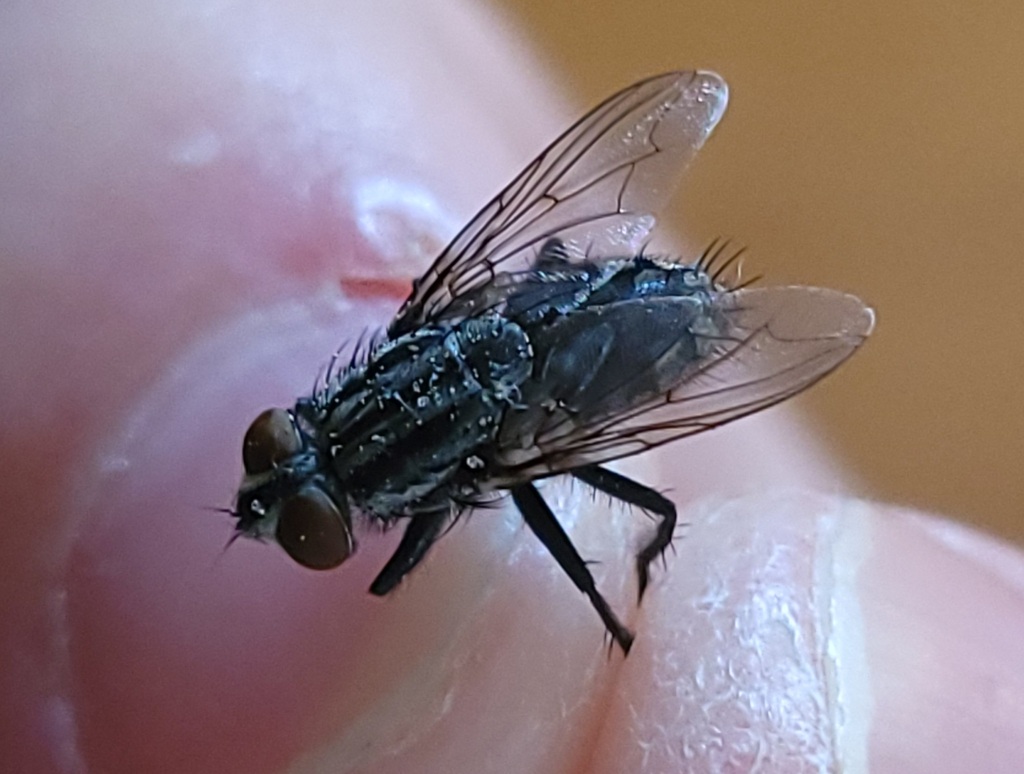
Grey flesh flies are 8 to 17 mm long, gray with three dark stripes on the thorax and a black-gray checkerboard abdomen. Adults feed on sweet substances while females deposit larvae directly onto carrion, and the flies can carry disease-causing bacteria.
Source: Wikipedia, University of Minnesota Extension, Utah State Extension
How to recognize it
The head is ashen grey and the antenna’s arista is feathered only at the base, unlike blow flies. Eyes are bright red and set far apart on the top of the head. The thorax has three dark longitudinal stripes, and the abdomen shows a black-gray checkerboard pattern.
Source: Wikipedia, University of Minnesota Extension, Utah State Extension
Size
They measure about 8 to 17 mm in length.
Source: Wikipedia
Is it a pest in the house?
Large numbers indoors in summer often indicate a dead animal in a wall or attic. They are considered a nuisance inside buildings but are not frequent indoor pests.
Source: University of Minnesota Extension, Utah State Extension
Does it bite or sting?
Flesh flies do not bite. They can spread disease through contact.
Source: University of Minnesota Extension, Utah State Extension
How to get rid of it
Locate and remove the breeding substrate, such as a dead animal, to control them. Light traps can catch flies that enter indoors.
Source: Utah State Extension
Where it lives
They are found in both rural and urban areas, often inside houses during summer months.
Source: Wikipedia
What it eats
They are scavengers that feed on carrion and dung.
Source: Wikipedia
When you see it
They are active from May to September, with peak numbers in August and September.
Source: Wikipedia
Lookalikes
They resemble blow flies but lack the metallic abdomen coloration.
Source: Wikipedia
Where it is found in the US
Recorded in 10 of 51 states and DC. Most records: Florida, Illinois, Massachusetts, Iowa, Kansas, New Hampshire, New Jersey, Ohio.
Darker = more records. Counts are museum and citizen-science records, not population size.
Source: GBIF
Status: native in Canada. Source: iNaturalist
Months it is reported in the US
Source: GBIF
Questions people ask
Can they spread disease?
Yes, they can carry and spread disease-causing bacteria through contact.
How can I get rid of them indoors?
Find and remove any dead animal or decaying matter they are breeding in, and use light traps to catch those that come inside.
Source: Utah State Extension
Same family (Sarcophagidae)

Sources
- University of Minnesota Extension: https://apps.extension.umn.edu/garden/diagnose/insect/indoor/flies/medium/flesh-flies.html
- Wikipedia: https://en.wikipedia.org/wiki/Sarcophaga_bullata
- Utah State Extension: https://extension.usu.edu/pests/ipm/notes_nuisance/flesh-flies
Look it up elsewhere: GBIF · iNaturalist · BugGuide · ITIS · Wikipedia
Text written 2026-10-23 from the sources above and checked sentence by sentence against them. Data fetched 2026-10-22.