 Bug FAQ
Gregarious Oak Leafminer Moth
Cameraria cincinnatiella · Order: Lepidoptera · Family: Gracillariidae
Also called: Gregarious Oak Leafminer
Source: Wikipedia
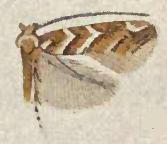
Adults have a wingspan of about 15 mm. It occurs in Ontario, Quebec, and across the United States. Larvae feed inside the leaves of oak trees such as white oak, bur oak, and post oak, creating leaf mines.
Source: Wikipedia
Size
The adult moth’s wingspan measures roughly 15 mm.
Source: Wikipedia
Where it lives
It is found in Ontario, Quebec, and throughout the United States.
Source: Wikipedia
What it eats
The larvae mine the leaves of oak species such as Quercus alba, Q. bicolor, Q. macrocarpa, Q. obtusiloba, Q. prinus, and Q. stellata.
Source: Wikipedia
Where it comes from
Its range includes Ontario, Quebec, and the United States.
Source: Wikipedia
Where it is found in the US
Recorded in 11 of 51 states and DC. Most records: Michigan, Massachusetts, Ohio, Virginia, Connecticut, Kentucky, Pennsylvania, Arkansas.
Darker = more records. Counts are museum and citizen-science records, not population size.
Source: GBIF
Status: native in North America; native in Canada; native in United States. Source: iNaturalist
Months it is reported in the US
Source: GBIF
More photos
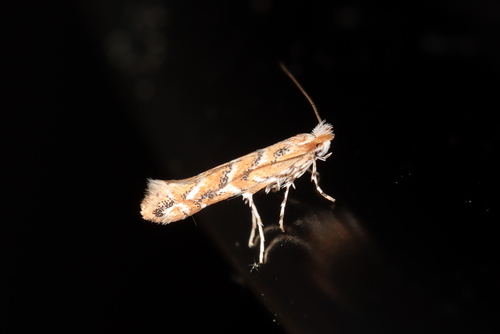
Questions people ask
How large is the Gregarious Oak Leafminer Moth?
Adults have a wingspan of about 15 mm.
Source: Wikipedia
Where is this moth found?
It occurs in Ontario, Quebec, and across the United States.
Source: Wikipedia
Does it damage trees?
Yes, leaf mining by the larvae harms the foliage of oak trees.
Source: Wikipedia
Same family (Gracillariidae)
 Horse-chestnut LeafminerCameraria ohridellaDamages trees, gardens or crops
 Aspen Serpentine Leafminer MothPhyllocnistis populiellaDamages trees, gardens or crops
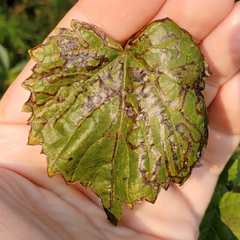 Phyllocnistis vitegenella complexPhyllocnistis vitegenellaDamages trees, gardens or crops
 Locust Digitate Leafminer MothParectopa robiniellaDamages trees, gardens or crops
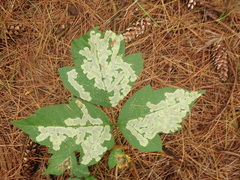 Poison Ivy Leaf-miner MothCameraria guttifinitella
 Phyllocnistis insignisDamages trees, gardens or crops
Sources
- Wikipedia: https://en.wikipedia.org/wiki/Cameraria_cincinnatiella
Look it up elsewhere: GBIF · iNaturalist · BugGuide · Wikipedia
Text written 2026-10-28 from the sources above and checked sentence by sentence against them. Data fetched 2026-10-28.