 Bug FAQ
Green Cone-headed Planthopper
Acanalonia conica · Order: Hemiptera · Family: Acanaloniidae
Also called: Green Coneheaded Planthopper
Source: Wikipedia

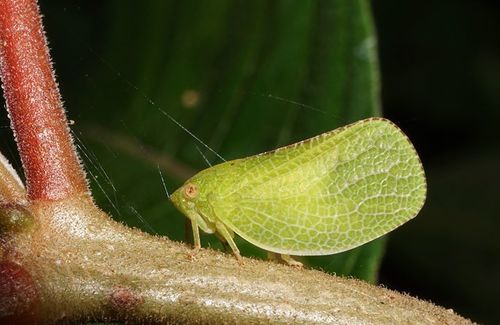
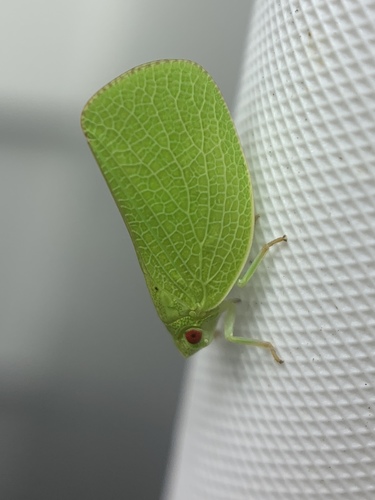
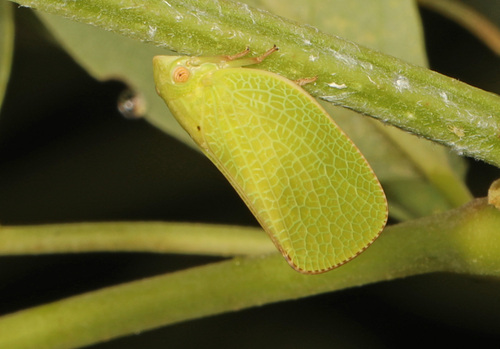
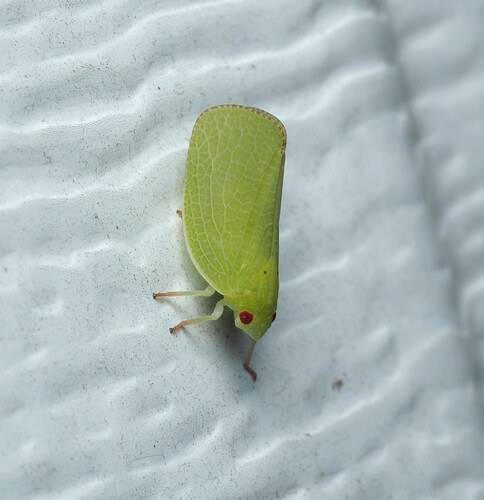
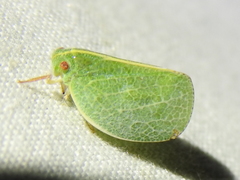
Adults are bright green with a cone-shaped head and red eyes, and their wings show a network of veins. They live in North America and Europe, often alongside three flatid planthopper species. The species is native to North America (Nearctic realm) and can develop on many host plants, including crops.
Source: Wikipedia
How to recognize it
Adults are bright green, have a conical head, red eyes, and their fore-wings display a visible vein network.
Source: Wikipedia
Where it lives
Found in North America and Europe, often sharing habitats with three flatid planthopper species.
Source: Wikipedia
What it eats
Very polyphagous; can develop on many host plants, including cultivated species.
Source: Wikipedia
Life cycle
Has one generation per year (univoltine).
Source: Wikipedia
When you see it
Eggs are laid individually in summer and autumn inside cuts made in woody plant tissue.
Source: Wikipedia
Where it comes from
Native to North America and the Nearctic realm.
Source: Wikipedia
Lookalikes
Its similarity to Metcalfa pruinosa raises concerns about its potential spread and pest status.
Source: Wikipedia
Where it is found in the US
Recorded in 38 of 51 states and DC. Most records: Ohio, Maryland, Virginia, Illinois, Pennsylvania, North Carolina, Texas, New York.
Darker = more records. Counts are museum and citizen-science records, not population size.
Source: GBIF
Months it is reported in the US
Source: GBIF
More photos
Questions people ask
Can it damage my garden plants?
Yes, it feeds on many cultivated plants and could become a pest in gardens or farms.
Source: Wikipedia
Same family (Acanaloniidae)

Sources
- Wikipedia: https://en.wikipedia.org/wiki/Acanalonia_conica
Look it up elsewhere: GBIF · iNaturalist · BugGuide · Wikipedia
Text written 2026-10-22 from the sources above and checked sentence by sentence against them. Data fetched 2026-10-22.