 Bug FAQ
Green Carpet
Colostygia pectinataria · Order: Lepidoptera · Family: Geometridae
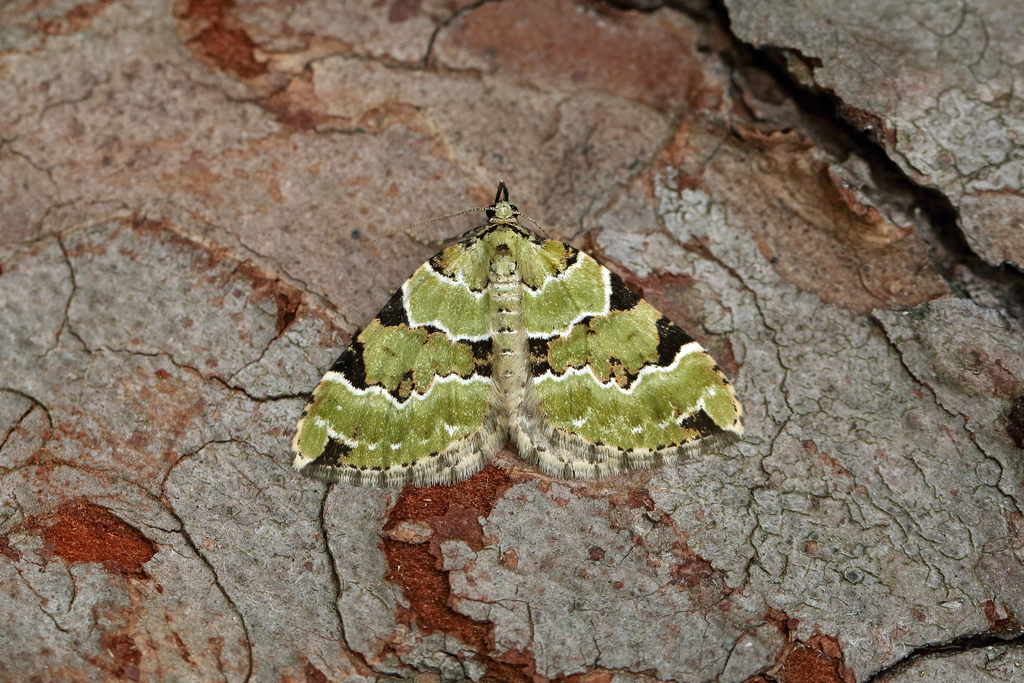
The green carpet moth has a wingspan of about 22 to 28 mm and is bright green with distinct dark-green and white patterned markings on the forewings, plus two blackish spots near the front edge and one near the inner edge. It flies at night in June and July, is attracted to light, and its larvae feed on plants such as Galium, Rumex and Lamium.
Source: Wikipedia
How to recognize it
The forewings are green to bluish-green with a pattern of brown-green at the base, brighter green next, a wide dark-green serrated discal area edged in white, a whitish-green postdiscal area and a brownish-green margin, plus two blackish spots near the costa and one on the inner edge. The hindwings are a shimmering grey-white with faint lines.
Source: Wikipedia
Size
Wingspan ranges from 22 to 28 mm (0.87 to 1.10 in).
Source: Wikipedia
Where it lives
It lives in many wet habitats such as moors, marshes, bogs, damp heath, forest edges and shady forests.
Source: Wikipedia
What it eats
Caterpillars feed mainly on Galium species but also on Rumex and Lamium.
Source: Wikipedia
Life cycle
Adults fly at night in June and July and are often attracted to light.
Source: Wikipedia
When you see it
The flight period is June to July.
Source: Wikipedia
More photos


Same family (Geometridae)
 Willow BeautyPeribatodes rhomboidaria
 Pale BeautyCampaea perlataDamages trees, gardens or crops
 Large Lace-border MothScopula limboundataDamages trees, gardens or crops
 Riband WaveIdaea aversata
 Yellow Shell MothCamptogramma bilineata
 Large Maple Spanworm MothProchoerodes lineolaDamages trees, gardens or crops
Sources
- Wikipedia: https://en.wikipedia.org/wiki/Colostygia_pectinataria
Look it up elsewhere: GBIF · iNaturalist · BugGuide · Wikipedia
Text written 2026-10-22 from the sources above and checked sentence by sentence against them. Data fetched 2026-10-22.