 Bug FAQ
Green-blotched Moth
Cosmodes elegans · Order: Lepidoptera · Family: Noctuidae
Also called: Spangled Green Owlet
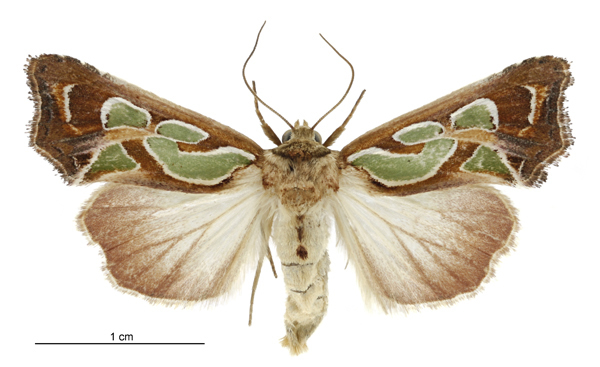
The green-blotched moth has a wingspan of about 4 cm and brown forewings with sinuous green markings; its hindwings are white fading to light brown and it has a hairy crest behind the head. Caterpillars grow to about 3 cm, are bright green with dark spiracles, and feed on Lobelia, Verbena and Wahlenbergia species.
Source: Wikipedia
How to recognize it
First wings are ferruginous with three greenish spots edged in silver, the front spot hooked; rear wings are reddish.
Source: Wikipedia
Size
Caterpillars reach about 3 cm (1.2 in) in length.
Source: Wikipedia
Where it lives
Adults live in forest clearings from January to May, where larvae cocoon among foliage.
Source: Wikipedia
What it eats
Larvae feed on plants in the Lobelia, Verbena and Wahlenbergia genera.
Source: Wikipedia
When you see it
Adults are on the wing year-round, but in New Zealand they are recorded most often from February to April.
Source: Wikipedia
Where it comes from
The species is native to Australia.
Source: Wikipedia
Lookalikes
The uniquely shaped forewing and its characteristic pattern make it unlikely to be confused with other species.
Source: Wikipedia
More photos

Questions people ask
What do the caterpillars look like?
They are bright green with dark spiracles on each side and grow to about 3 cm long.
Source: Wikipedia
When can I see adult green-blotched moths?
Adults are active throughout the year, but in New Zealand they are most often seen from February to April.
Source: Wikipedia
What plants do the larvae eat?
The larvae feed on species of Lobelia, Verbena and Wahlenbergia.
Source: Wikipedia
Where does this moth live?
It lives in forest clearings in Australia and sometimes appears in New Zealand during summer.
Source: Wikipedia
Same family (Noctuidae)
 Ipsilon Dart MothAgrotis ipsilonDamages trees, gardens or crops
 Fall Armyworm MothSpodoptera frugiperdaDamages trees, gardens or crops
 Army Cutworm MothEuxoa auxiliarisDamages trees, gardens or crops
 Large Yellow UnderwingNoctua pronubaDamages trees, gardens or crops
 Silver ΥAutographa gamma
 American DaggerAcronicta americanaCan irritate skin
Sources
- Wikipedia: https://en.wikipedia.org/wiki/Cosmodes_elegans
Look it up elsewhere: GBIF · iNaturalist · BugGuide · Wikipedia
Text written 2026-10-22 from the sources above and checked sentence by sentence against them. Data fetched 2026-10-22.