 Bug FAQ
Great Southern White
Ascia monuste · Order: Lepidoptera · Family: Pieridae
Source: Wikipedia
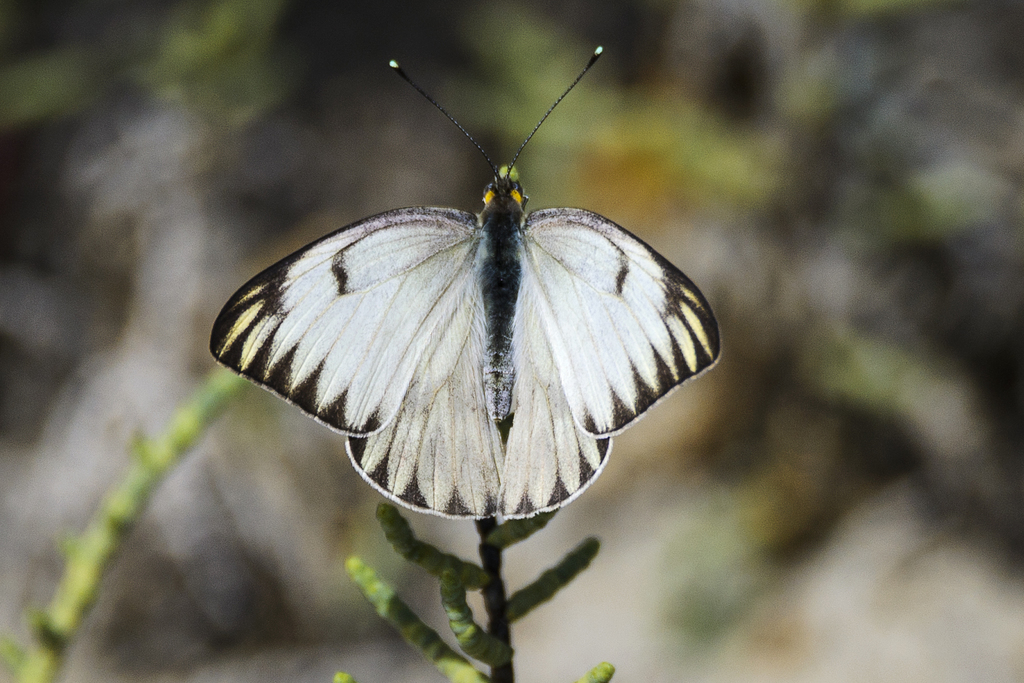
The great southern white butterfly is found from the U.S. Atlantic and Gulf coasts down to Argentina and migrates along the southeastern U.S. coast. Adults have a wingspan of about 2.5 to 3.4 inches and live several days, feeding on nectar from flowers such as saltwort, lantana, and verbena. Its larvae can completely destroy crucifer vegetable crops in southern Texas, and control methods include pesticides and host-plant resistance.
Source: Wikipedia
How to recognize it
Females may be either light-colored or dark-colored, while males differ in appearance.
Source: Wikipedia
Size
The adult’s wingspan ranges from about 63 to 86 mm (2.5 to 3.4 inches). A fully grown adult is roughly one and a quarter inches long.
Source: Wikipedia
Is it a pest in the house?
It is an occasional pest of crucifer vegetables in southern Texas. Larvae feed on the leaves for most of their development, and can cause total loss of a crop.
Source: Wikipedia
How to get rid of it
Pesticides can be used to reduce damage. Developing resistant host plants is being explored as a safer, more sustainable option.
Source: Wikipedia
What it eats
Adults sip nectar from a variety of flowers, including saltwort, lantana, and verbena.
Source: Wikipedia
Life cycle
Eggs develop in about 4 to 5 days in the field and roughly 3.4 days in the lab. Pupation lasts from about 6 to 10 days, and adult males live 4 to 5 days while females live 8 to 10 days.
Source: Wikipedia
When you see it
Adults are present throughout the year in the southern parts of its range. The species migrates in one direction during its lifespan and does not return.
Source: Wikipedia
Where it comes from
It migrates along the southeastern U.S. coast, with occasional strays reaching Maryland, Kansas, and Colorado.
Source: Wikipedia
Lookalikes
The great southern white belongs to the Pieridae family and is the only species in the genus Ascia.
Source: Wikipedia
Where it is found in the US
Recorded in 17 of 51 states and DC. Most records: Florida, Texas, Georgia, Arizona, Louisiana, South Carolina, Mississippi, Virginia.
Darker = more records. Counts are museum and citizen-science records, not population size.
Source: GBIF
Status: native in North America. Source: iNaturalist
Months it is reported in the US
Source: GBIF
More photos

Questions people ask
What plants does it damage?
Its caterpillars feed on crucifer vegetables and can destroy an entire crop in southern Texas.
Source: Wikipedia
How can I control it in my garden?
You can use pesticides or plant varieties that are resistant to the larvae.
Source: Wikipedia
Same family (Pieridae)


Sources
- Wikipedia: https://en.wikipedia.org/wiki/Ascia
Look it up elsewhere: GBIF · iNaturalist · BugGuide · ITIS · Wikipedia
Text written 2026-10-22 from the sources above and checked sentence by sentence against them. Data fetched 2026-10-22.