 Bug FAQ
Grass Webworm Moth
Herpetogramma licarsisalis · Order: Lepidoptera · Family: Crambidae
Also called: Tropical Grass Webworm Moth, Grass Webworm, Tropical Grass Webworm
Source: Wikipedia
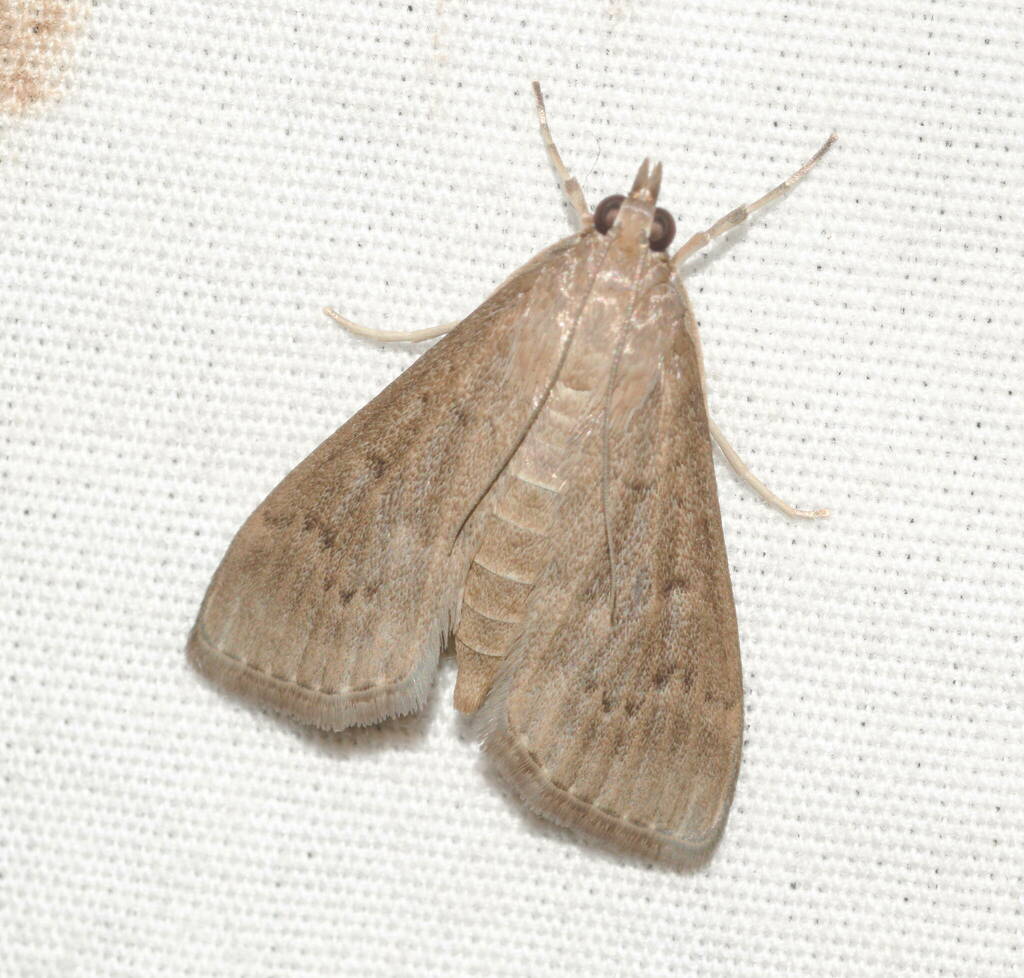
Adults have a wingspan of about 24 mm, while full-grown caterpillars reach roughly 20 mm in length. The larvae live inside silk-lined leaf tubes and feed on many grass species and other plants, making them a common pest of lawns, pastures and crops.
Source: Wikipedia
How to recognize it
First-instar larvae have a black head capsule; later stages develop a brown head capsule. Mature caterpillars are green to brown, sometimes showing a rose tint.
Source: Wikipedia
Size
The adult moth’s wingspan is about 24 mm. Full-grown larvae measure about 20 mm long.
Source: Wikipedia
Where it lives
It occurs throughout most Old World tropical regions, from Africa to Asia, Australia and New Zealand.
Source: Wikipedia
What it eats
Larvae feed on a wide variety of grasses (Poaceae) such as Bermuda grass, crabgrass, rice, sorghum, maize and many others, and also on several non-grass plants.
Source: Wikipedia
Life cycle
Eggs are flat, elliptical and laid singly or in clusters on the upper leaf surface near the midrib. After 4 to 6 days the eggs hatch; the caterpillars pass through five instars over about two weeks. Pupation occurs in a loosely woven silk hibernaculum and lasts roughly 7 days. Adult moths live for about 13 days after emerging from the pupa.
Source: Wikipedia
When you see it
All major activities, mating, egg-laying, hatching, feeding, molting, pupation and adult emergence, take place at night.
Source: Wikipedia
Where it comes from
Its distribution covers the Old World tropics, including many African, Asian and Pacific countries.
Source: Wikipedia
Where it is found in the US
Recorded in 3 of 51 states and DC. Most records: Hawaii, Massachusetts, New Jersey.
Darker = more records. Counts are museum and citizen-science records, not population size.
Source: GBIF
Status: introduced in United States. Source: iNaturalist
Months it is reported in the US
Source: GBIF
More photos


Questions people ask
What crops can they damage?
The larvae feed on many grasses and cereals, including rice, wheat, sorghum, maize and lawn grasses, causing chewing damage.
Source: Wikipedia
When are they active?
They are strictly nocturnal; all life-stage activities happen at night.
Source: Wikipedia
Same family (Crambidae)
 Box Tree MothCydalima perspectalisDamages trees, gardens or crops
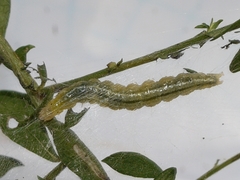 Celery Leaftier MothUdea rubigalisDamages trees, gardens or crops
 Elegant Grass-veneerMicrocrambus elegans
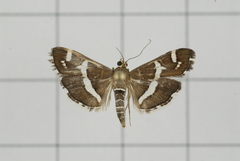 Hawaiian Beet Webworm MothSpoladea recurvalisDamages trees, gardens or crops
 Garden Grass-veneerChrysoteuchia culmellaDamages trees, gardens or crops
 Bluegrass Webworm MothParapediasia teterrellusDamages trees, gardens or crops
Sources
- Wikipedia: https://en.wikipedia.org/wiki/Herpetogramma_licarsisalis
Look it up elsewhere: GBIF · iNaturalist · BugGuide · Wikipedia
Text written 2026-10-22 from the sources above and checked sentence by sentence against them. Data fetched 2026-10-22.