 Bug FAQ
Grapeleaf Skeletonizer Moth
Harrisina americana · Order: Lepidoptera · Family: Zygaenidae
Also called: Grapeleaf Skeletonizer
Source: Wikipedia
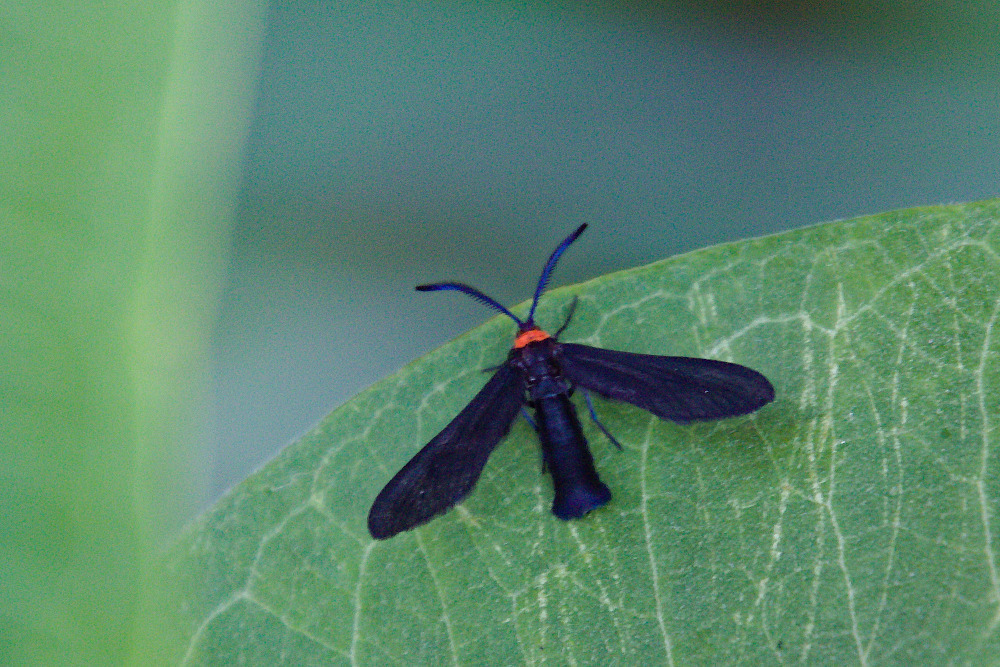
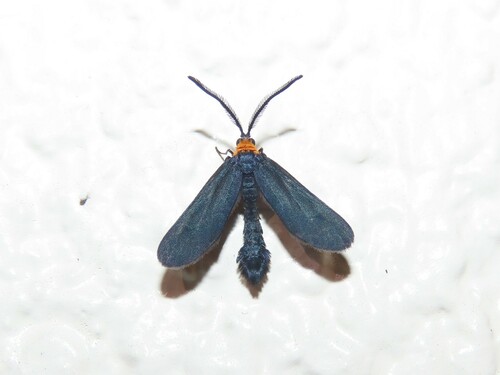
The grapeleaf skeletonizer moth is a small, narrow-winged insect with a reddish collar and black wings, found throughout the eastern United States. Larvae feed together on grape leaves, eventually becoming solitary, and the species can have multiple generations per year in the south. Adults are active both day and night, and the pupal stage overwinters among leaf litter at the base of the host plant.
Source: Wikipedia
How to recognize it
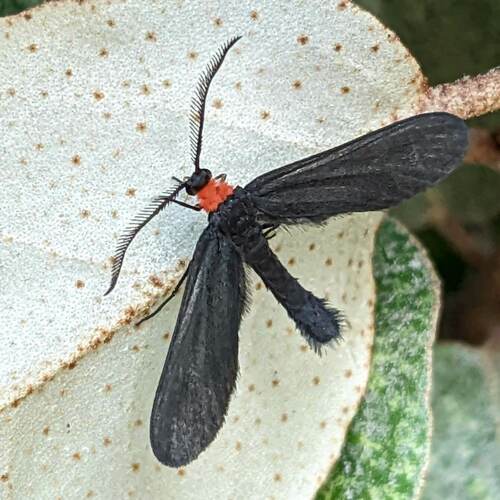
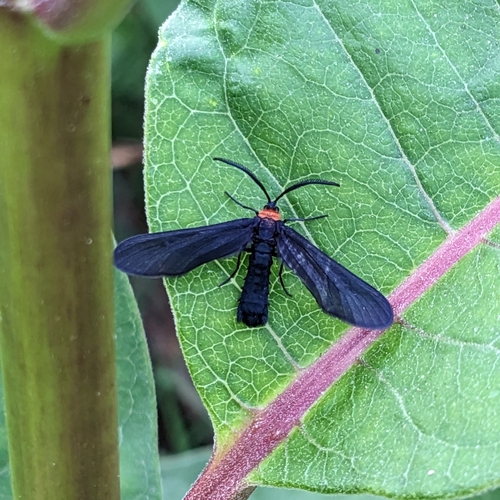
Adults have long, narrow black wings held away from the body and a reddish or orange collar, with the abdomen curled upward and a hair tuft at the tip.
Source: Wikipedia
Size
The moth’s wingspan ranges from 18 to 28 mm and its body length is 8 to 12 mm; larvae can grow up to 15 mm long.
Source: Wikipedia
Does it bite or sting?
All members of this family produce hydrogen cyanide as a defensive toxin, and their hair-like setae can cause a rash lasting several days if brushed against.
Source: Wikipedia
Where it lives
They live on the underside of leaves and are common across the eastern half of the United States.
Source: Wikipedia
What it eats
The larvae feed gregariously on grape foliage, with groups getting smaller as they mature.
Source: Wikipedia
When you see it
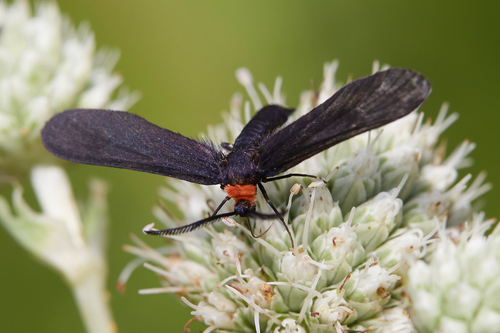
Adults visit flowers during the day and night, and the pupae overwinter among leaf litter at the plant base.
Source: Wikipedia
Where it comes from
Their distribution is widespread in the eastern United States.
Source: Wikipedia
Lookalikes
The western grapeleaf skeletonizer (Harrisina metallica) looks similar but is slightly larger and occurs in a different geographic range.
Source: Wikipedia
Where it is found in the US
Recorded in 41 of 51 states and DC. Most records: Texas, Florida, Alabama, North Carolina, Virginia, Louisiana, Maryland, Georgia.
Darker = more records. Counts are museum and citizen-science records, not population size.
Source: GBIF
Status: native in North America; native in Canada. Source: iNaturalist
Months it is reported in the US
Source: GBIF
More photos
Questions people ask
Do they bite or sting people?
Their hair-like setae give a rash that lasts several days if you brush against them.
Source: Wikipedia
Are they a problem for grape vines?
Yes, the larvae feed in groups on grape leaves, which can damage the foliage.
Source: Wikipedia
When are the adults active?
Adults are active both during the day and at night, visiting flowers.
Source: Wikipedia
How many generations do they have each year?
In the southern part of their range they have several generations per year, while in the north they usually have one.
Source: Wikipedia
Same family (Zygaenidae)
Sources
- Wikipedia: https://en.wikipedia.org/wiki/Grapeleaf_skeletonizer
Look it up elsewhere: GBIF · iNaturalist · BugGuide · Wikipedia
Text written 2026-10-22 from the sources above and checked sentence by sentence against them. Data fetched 2026-10-22.