 Bug FAQ
Golden-tailed Leafwalker
Xylota sylvarum · Order: Diptera · Family: Syrphidae
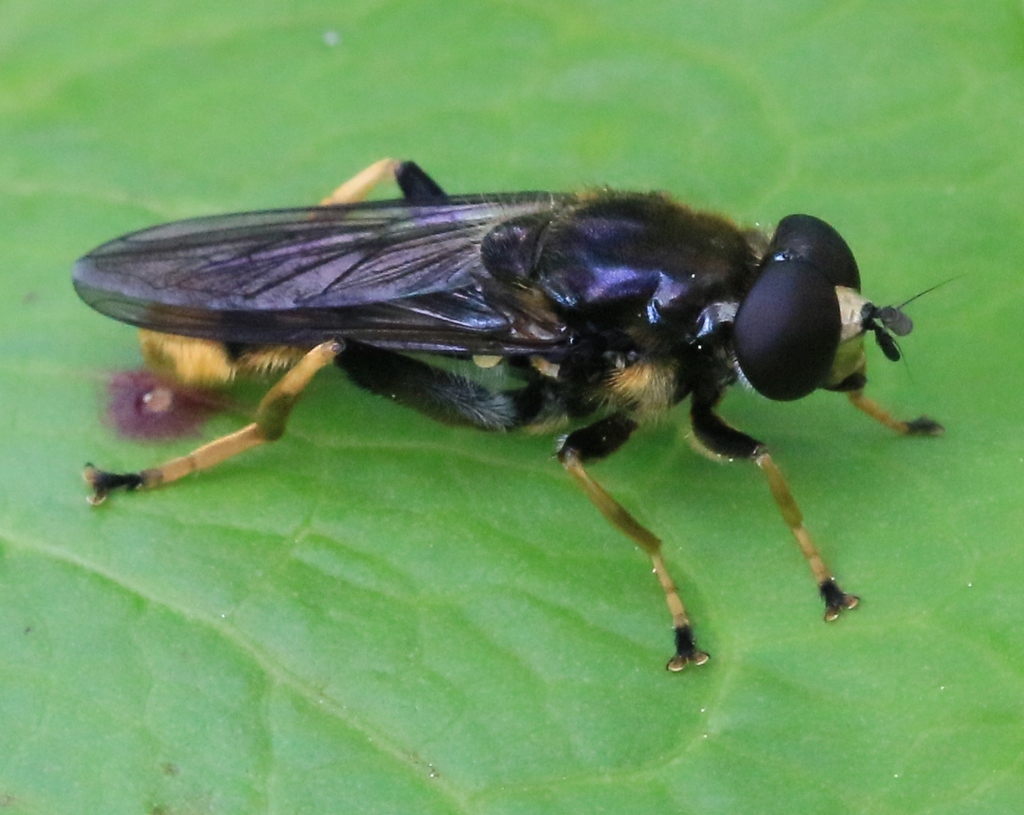
The Golden-tailed Leafwalker is a hoverfly with a wing length of about 9 to 12 mm. Its thorax is dark, the front legs are partly yellow, and the abdomen is black with shiny golden hair patches. It lives in old woodlands, running over leaves and stems, and its larvae develop in damp, fungus-filled dead wood of fir, beech and oak.
Source: Wikipedia
How to recognize it
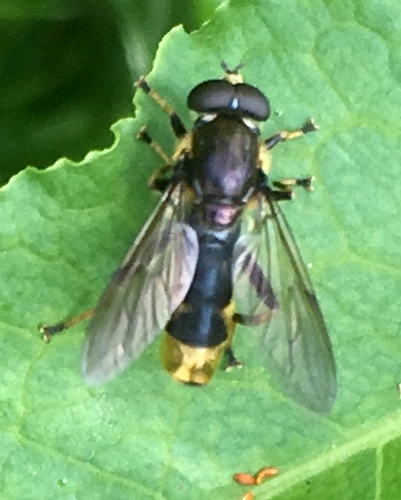
Thorax dark-brown to black, front legs partly yellow, abdomen black with golden-colored hair patches.
Source: Wikipedia
Size
Wing length ranges from 9 to 12 mm.
Source: Wikipedia
Where it lives
Found in old woodland, moving on foliage of bushes, shrubs and tree stumps. Larvae feed in damp, fungus-rich decaying wood of fir, beech and oak trunks and stumps, usually under the bark.
Source: Wikipedia
What it eats
Larvae eat decaying wood that is moist and colonised by fungi, especially of fir, beech and oak.
Source: Wikipedia
Life cycle
The larval stage has been illustrated in colour by Rotheray (1994).
Source: Wikipedia
Where it comes from
Occurs across the Palearctic from Fennoscandia south to Iberia, and from Ireland east through northern Europe to Siberia and the Pacific coast.
Source: Wikipedia
Lookalikes
It is a common Palearctic hoverfly species, Xylota sylvarum.
Source: Wikipedia
More photos
Questions people ask
How can I recognise a Golden-tailed Leafwalker?
Look for a hoverfly about 9 to 12 mm wing length, dark thorax, front legs partly yellow, and a black abdomen with golden hair patches.
Source: Wikipedia
Where does this hoverfly live?
It lives in old woodlands, running on leaves and stems of bushes, shrubs and tree stumps, while its larvae develop in damp, fungus-filled dead wood of fir, beech and oak.
Source: Wikipedia
Same family (Syrphidae)






Sources
- Wikipedia: https://en.wikipedia.org/wiki/Xylota_sylvarum
Look it up elsewhere: GBIF · iNaturalist · BugGuide · Wikipedia
Text written 2026-10-23 from the sources above and checked sentence by sentence against them. Data fetched 2026-10-22.