 Bug FAQ
Gigantiops destructor
Gigantiops destructor · Order: Hymenoptera · Family: Formicidae
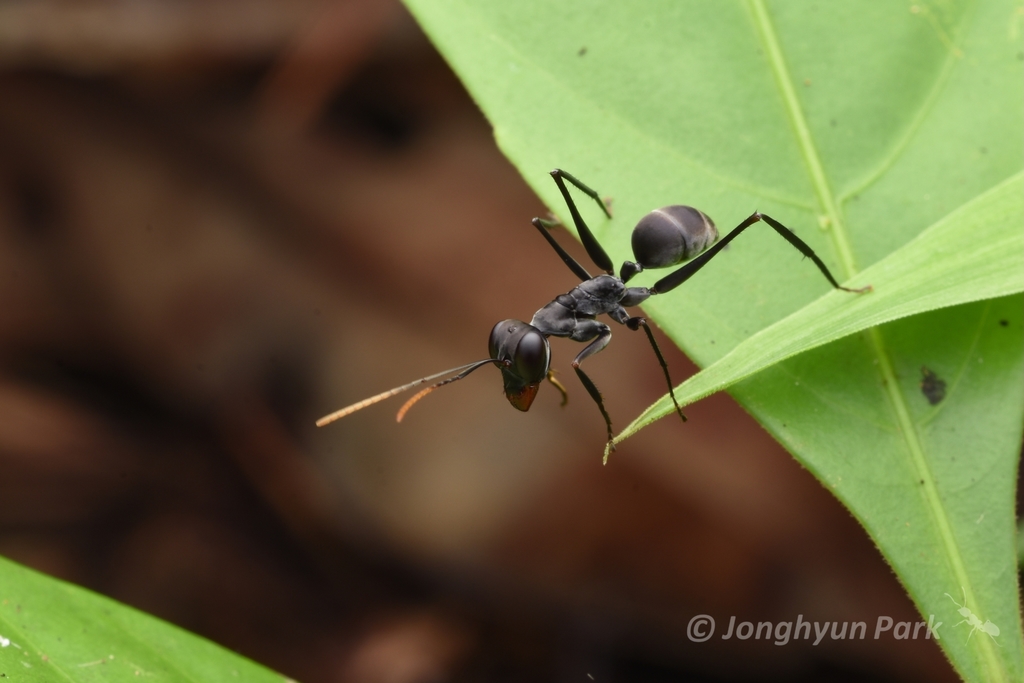
These ants have the biggest eyes of any ant and can jump, and they carry the most chromosomes in their subfamily (2n=78). They live in soil, rotting wood, or cavities made by other animals and are found from about 10° N to 15° S in the Amazon region, feeding on extrafloral nectar and small arthropods.
Source: Wikipedia
How to recognize it
They have the largest eyes of any ant and are known for jumping.
Source: Wikipedia
Where it lives
Their range spans roughly 10° north to 15° south of the equator.
Source: Wikipedia
What it eats
Larvae are fed chewed prey.
Source: Wikipedia
Life cycle
They share the same notable features of large eyes, jumping ability, and high chromosome count.
Source: Wikipedia
Where it comes from
The genus is native to the Amazon region of South America.
Source: Wikipedia
More photos


Same family (Formicidae)
 Eastern Black Carpenter AntCamponotus pennsylvanicusCan damage your home
 Red Imported Fire AntSolenopsis invictaCan sting
 American Winter AntPrenolepis imparis
 Argentine AntLinepithema humileNuisance, not dangerous
 Immigrant Pavement AntTetramorium immigransCan sting
 Odorous House AntTapinoma sessileCan damage your home
Sources
- Wikipedia: https://en.wikipedia.org/wiki/Gigantiops
Look it up elsewhere: GBIF · iNaturalist · BugGuide · ITIS · Wikipedia
Text written 2026-10-23 from the sources above and checked sentence by sentence against them. Data fetched 2026-10-23.