 Bug FAQ
Giant Woodwasp
Urocerus gigas · Order: Hymenoptera · Family: Siricidae
Also called: Banded Horntail, Giant Horntail, Giant Wood Wasp, Greater Horntail
Source: Wikipedia

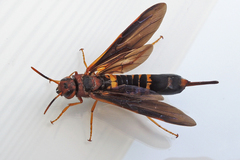
Adults range from about a half-inch to one and a half inches long (10 to 40 mm). They look like wasps because of mimicry, but they have a hard spike on the end of the abdomen. The insects bore into soft, freshly cut or weakened wood, leaving round tunnels packed with coarse, fibrous sawdust.
Source: Wikipedia
How to recognize it
Both males and females have a chitinous spine at the tip of the abdomen, a trait common to all woodwasps. Their body shape and coloration imitate true wasps, which is a form of protective mimicry.
Source: Wikipedia
Size
Adults measure between 10 and 40 mm in length, roughly half an inch to one and a half inches.
Source: Wikipedia
Is it a pest in the house?
The woodwasp attacks softwood in freshly felled logs and weakened trees, which can include timber used in homes. Its tunnels are packed with hard, fibrous sawdust that is tough to clean out of wood structures.
Source: Wikipedia
Does it bite or sting?
The abdominal spine is harmless and the insect cannot sting. Females also have a longer lower projection, the ovipositor, used for laying eggs.
Source: Wikipedia
Where it lives
They infest softwoods of freshly felled logs or trees that are already weakened. The insects live in distinct, round tunnels that are often filled with hard, coarse frass that is difficult to remove.
Source: Wikipedia
What it eats
Females drill holes with a saw-toothed ovipositor and lay eggs inside soft wood, where the larvae feed on the wood tissue. Overall, the species bores into and consumes softwood of freshly cut or unhealthy trees.
Source: Wikipedia
Where it comes from
Since 2004 the giant woodwasp has been present in North America. It is originally native to the Palearctic region and North Africa.
Source: Wikipedia
Lookalikes
Although they are not true wasps, they resemble them because of mimicry. A related species, Urocerus flavicornis, was once thought to be a subspecies but is now recognized as separate.
Source: Wikipedia
Where it is found in the US
Recorded in 20 of 51 states and DC. Most records: Oregon, Colorado, Alaska, Michigan, Arizona, Wyoming, New Hampshire, New York.
Darker = more records. Counts are museum and citizen-science records, not population size.
Source: GBIF
Months it is reported in the US
Source: GBIF
More photos


Questions people ask
What damage can they cause in my house?
They bore into soft wood and leave round tunnels filled with hard, fibrous sawdust that is difficult to remove.
Source: Wikipedia
How can I tell they are not real wasps?
They have a hard chitinous spike on the abdomen and lack a stinger, unlike true wasps.
Source: Wikipedia
Where are giant woodwasps found?
They have been present in North America since 2004 and are originally native to the Palearctic region and North Africa.
Source: Wikipedia
Same family (Siricidae)


Sources
- Wikipedia: https://en.wikipedia.org/wiki/Urocerus_gigas
Look it up elsewhere: GBIF · iNaturalist · BugGuide · Wikipedia
Text written 2026-10-23 from the sources above and checked sentence by sentence against them. Data fetched 2026-10-22.