 Bug FAQ
Gem Moth
Orthonama obstipata · Order: Lepidoptera · Family: Geometridae
Also called: The Gem
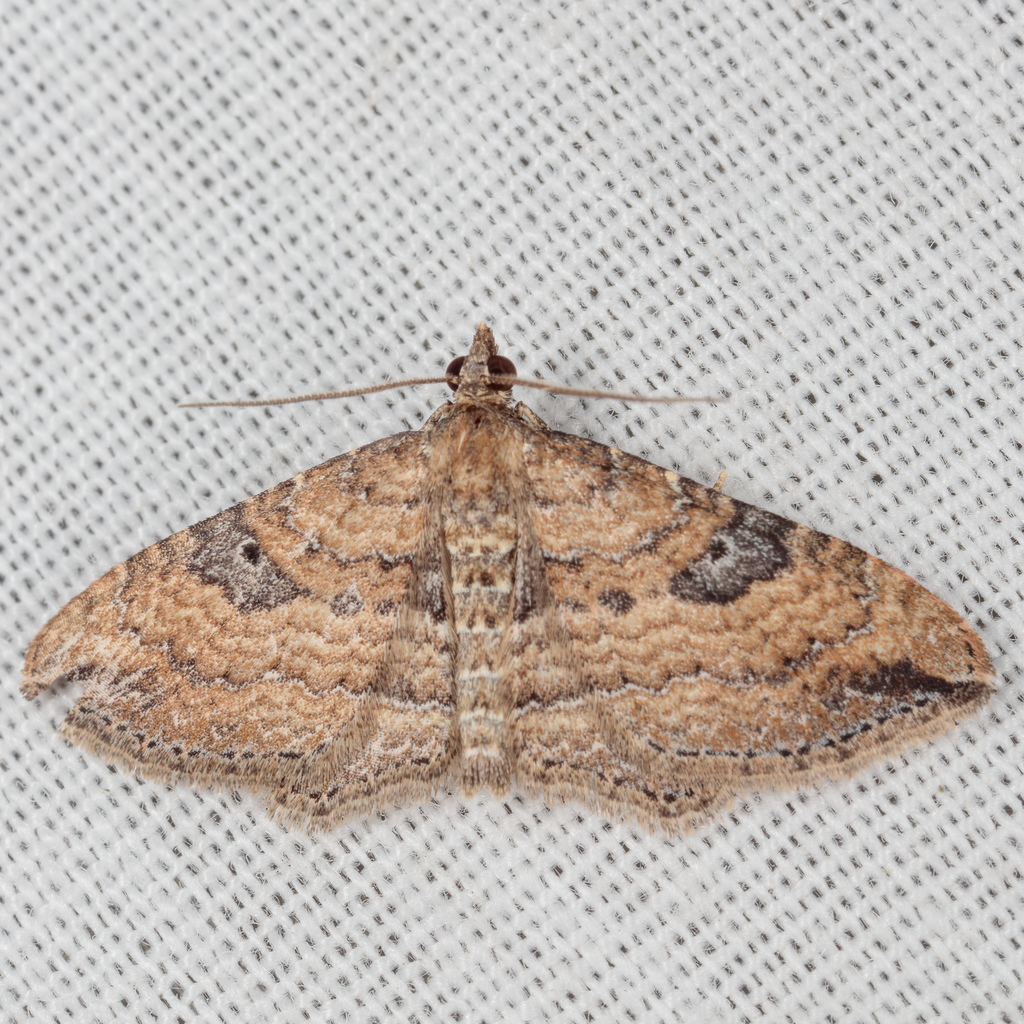
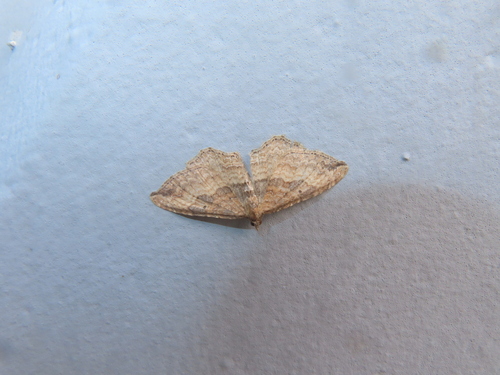
The adult gem moth has a wingspan of about 18 to 21 mm and the male shows light brown wings with wavy whitish lines and a dark band that forms concentric semicircles when at rest, plus a small whitish-rimmed black spot on each forewing. It is a strong flyer that often wanders far, so it can be found across the British Isles and even Iceland, though it is mainly a southern species. In its core European range it appears from April to November, while in more peripheral areas it is usually seen only in late summer and early autumn.
Source: Wikipedia
How to recognize it
Males are light brown with wavy whitish lines and a broad dark band that looks like concentric semicircles when the moth rests. Each forewing has a small black spot edged in white within the dark band near the centre and leading edge.
Source: Wikipedia
Size
The wingspan ranges from 18 to 21 mm (0.71 to 0.83 in).
Source: Wikipedia
Where it lives
It is a good flyer that can cross open sea and is regularly found in the British Isles and Iceland, especially in the south.
Source: Wikipedia
What it eats
Caterpillars eat many low-growing core eudicots, preferring asterids, with recorded host plants in central Europe.
Source: Wikipedia
Life cycle
In core areas like Belgium and the Netherlands adults are seen from April to November; in outlying regions they appear mainly in late summer and early autumn.
Source: Wikipedia
When you see it
Seasonal appearance matches the life-cycle notes: April-November in core range, late summer-early autumn in peripheral zones.
Source: Wikipedia
Where it comes from
The species is cosmopolitan but in continental Europe it does not extend far beyond the Baltic region and is absent from northern Russia.
Source: Wikipedia
Lookalikes
Male gem moths can be confused with grey-brown Xanthorhoe designata, but the latter has a reddish-brown midfield bounded by a narrow black band.
Source: Wikipedia
Where it is found in the US
Recorded in 48 of 51 states and DC. Most records: Texas, Maryland, Ohio, Pennsylvania, New York, Alabama, North Carolina, Massachusetts.
Darker = more records. Counts are museum and citizen-science records, not population size.
Source: GBIF
Status: native in North America; native in Canada; native in United States. Source: iNaturalist
Months it is reported in the US
Source: GBIF
More photos
Same family (Geometridae)
 Willow BeautyPeribatodes rhomboidaria
 Pale BeautyCampaea perlataDamages trees, gardens or crops
 Large Lace-border MothScopula limboundataDamages trees, gardens or crops
 Riband WaveIdaea aversata
 Yellow Shell MothCamptogramma bilineata
 Large Maple Spanworm MothProchoerodes lineolaDamages trees, gardens or crops
Sources
- Wikipedia: https://en.wikipedia.org/wiki/Orthonama_obstipata
Look it up elsewhere: GBIF · iNaturalist · BugGuide · ITIS · Wikipedia
Text written 2026-10-22 from the sources above and checked sentence by sentence against them. Data fetched 2026-10-22.