 Bug FAQ
Furry Dronefly
Eristalis intricaria · Order: Diptera · Family: Syrphidae
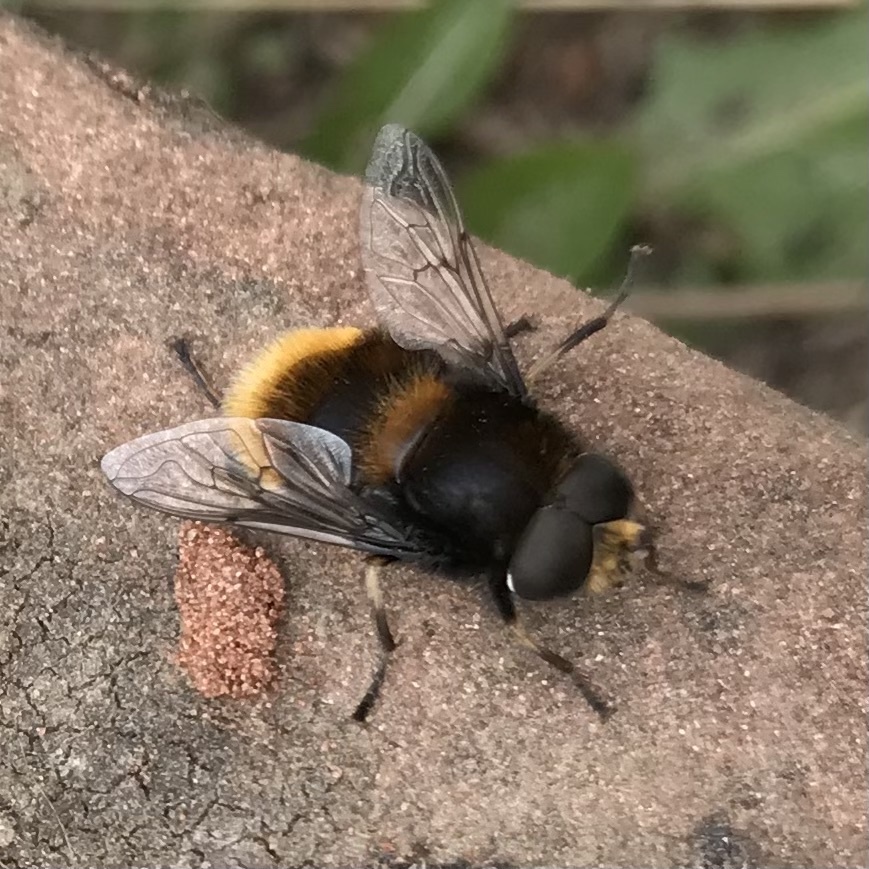
The furry dronefly has wing length about 8 to 12 mm and a densely hairy thorax and abdomen; males have brownish hairs and females have blackish hairs with white hairs on the last segment. It lives in wetland, raised bog, fen, marshy woodland and seasonally flooded grassland across the Palaearctic from Fennoscandia and the Faroes to central Spain and east to East Siberia. Adults visit many flowers while larvae develop in mud, peat, field drains and water-logged dung; they are on the wing from mid-April to late August.
Source: Wikipedia
How to recognize it
Thorax and abdomen are covered with long, dense hairs that can be tawny or black, and the sexes differ in hair colour with males brown-haired and females black-haired plus white hairs on the last tergite.
Source: Wikipedia
Size
Wing length ranges from 8.25 to 12 mm.
Source: Wikipedia
Where it lives
Found in wetland habitats such as raised bogs, fens, fen carr, poorly drained deciduous forest, humid seasonally flooded grassland, boreal forests, taiga and montane tundra. Also occurs in woodland and marshland.
Source: Wikipedia
What it eats
Larvae develop in mud, fen peat beside water, field drains, slurry and water-logged cow dung.
Source: Wikipedia
Life cycle
Adults are on the wing from mid-April to the end of August. The larva has been illustrated by Hartley (1961).
Source: Wikipedia
When you see it
Flight period in the UK runs from March to September, generally mid-April to late August.
Source: Wikipedia
Lookalikes
It mimics furry bees and looks similar to Merodon hoverflies, but Merodon have entirely black leg tibiae while this species has partly yellow tibiae.
Source: Wikipedia
Questions people ask
When can I expect to see furry droneflies?
Adults fly from early spring through late summer, roughly March to September in the UK.
Source: Wikipedia
What habitats should I check for furry dronefly larvae?
Look in wet mud, peat near water, field drains, slurry and water-logged cow dung.
Source: Wikipedia
What flowers do adult furry droneflies visit?
They visit many flowers such as white umbellifers, yellow composites, and a variety of shrubs and herbs like Calluna, Crataegus, and Salix.
Source: Wikipedia
How can I tell a furry dronefly apart from a Merodon hoverfly?
Merodon have all-black leg tibiae, while the furry dronefly has partly yellow tibiae.
Source: Wikipedia
Same family (Syrphidae)






Sources
- Wikipedia: https://en.wikipedia.org/wiki/Eristalis_intricaria
Look it up elsewhere: GBIF · iNaturalist · BugGuide · Wikipedia
Text written 2026-10-22 from the sources above and checked sentence by sentence against them. Data fetched 2026-10-22.