 Bug FAQ
Formica cunicularia
Formica cunicularia · Order: Hymenoptera · Family: Formicidae
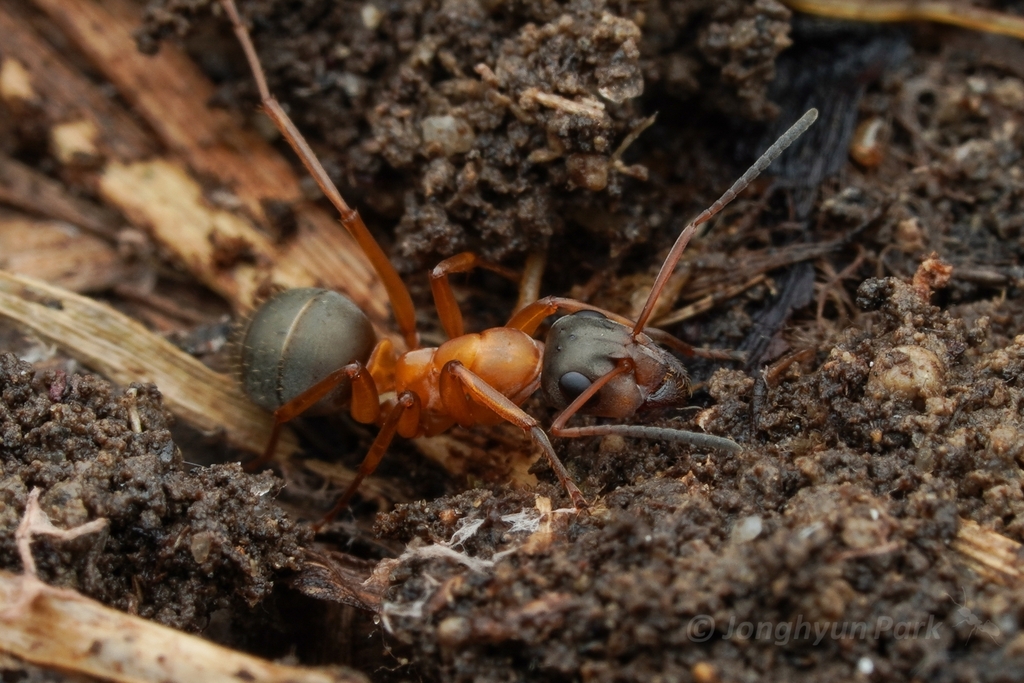
Workers are ashy-grey black and measure about 4 to 6.5 mm. Queens are yellow-red to dark black and 7.5 to 9 mm long.
Source: Wikipedia
How to recognize it
Workers are ashy-grey black; queens are yellow-red to dark black.
Source: Wikipedia
Size
Workers are 4.0 to 6.5 mm long. Males are 8.0 to 9.0 mm long. Queens are 7.5 to 9.0 mm long.
Source: Wikipedia
Where it lives
Found in habitats ranging from open to visually rich areas. In Finland they nest under stones or small earth mounds in dry, hot, low-vegetation sites.
Source: Wikipedia
What it eats
In arid regions they mainly eat seeds. They are predaceous and also scavenge.
Source: Wikipedia
Life cycle
Colonies are small, about 5 000 individuals. They can be hosts for the slave-making ant Polyergus rufescens.
Source: Wikipedia
Lookalikes
Often confused with Formica rufibarbis.
Source: Wikipedia
Questions people ask
What do the workers of Formica cunicularia look like?
Workers are ashy-grey black and about 4 to 6.5 mm long.
Source: Wikipedia
Where does Formica cunicularia build its nests?
They nest under stones or small earth mounds in dry, hot areas with low vegetation, especially in Finland.
Source: Wikipedia
What do these ants eat?
In dry regions they mainly feed on seeds, but they also hunt other insects and scavenge.
Source: Wikipedia
Same family (Formicidae)
 Eastern Black Carpenter AntCamponotus pennsylvanicusCan damage your home
 Red Imported Fire AntSolenopsis invictaCan sting
 American Winter AntPrenolepis imparis
 Argentine AntLinepithema humileNuisance, not dangerous
 Immigrant Pavement AntTetramorium immigransCan sting
 Odorous House AntTapinoma sessileCan damage your home
Sources
- Wikipedia: https://en.wikipedia.org/wiki/Formica_cunicularia
Look it up elsewhere: GBIF · iNaturalist · BugGuide · ITIS · Wikipedia
Text written 2026-10-23 from the sources above and checked sentence by sentence against them. Data fetched 2026-10-22.