 Bug FAQ
Florida White
Glutophrissa drusilla · Order: Lepidoptera · Family: Pieridae
Also called: Tropical White

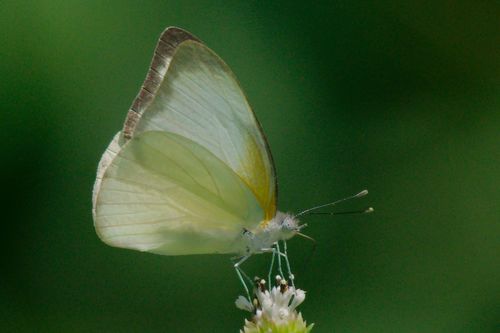
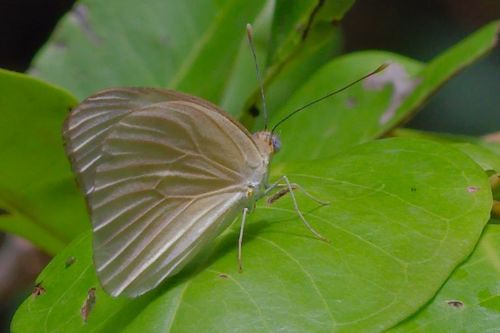
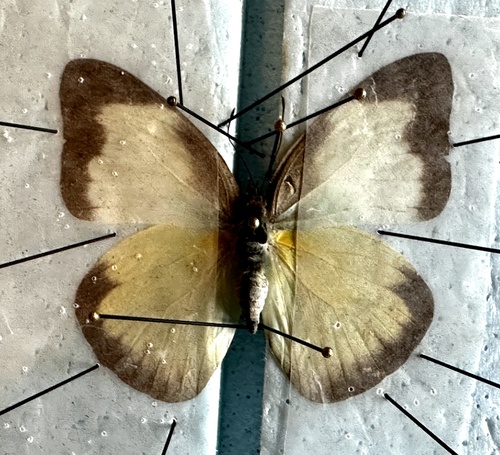
The Florida White butterfly has a wingspan of about 2 to 3 inches. Males are solid white with a thin black edge on the forewing, while females come in a plain white dry-season form or a wet-season form with black edging and a yellow-orange hindwing. It lives in tropical lowland evergreen or semi-deciduous forests from Brazil up through southern Florida and the Florida Keys.
Source: Wikipedia
How to recognize it
Males are solid white on both wing surfaces except for a narrow black edge along the forewing costal margin. Females have two forms: a dry-season all-white form and a wet-season form with black forewing edging and a yellow-orange upper hindwing.
Source: Wikipedia
Size
The wingspan ranges from 53 to 77 mm (about 2.1 to 3.0 inches).
Source: Wikipedia
Where it lives
It inhabits tropical lowland evergreen or semi-deciduous forests.
Source: Wikipedia
What it eats
Caterpillars feed on plants that contain glucosinolates, specifically members of the Capparaceae, Cleomaceae, and Putranjivaceae families.
Source: Wikipedia
Life cycle
The dry-season form flies from October through April, while the wet-season form is on the wing from May through September.
Source: Wikipedia
Where it comes from
It is found from Brazil northward to southern peninsular Florida, the Florida Keys, and the Antilles.
Source: Wikipedia
Where it is found in the US
Recorded in 10 of 51 states and DC. Most records: Texas, Florida, Arizona, Kansas, Maryland, Oklahoma, Colorado, Georgia.
Darker = more records. Counts are museum and citizen-science records, not population size.
Source: GBIF
Status: native in North America. Source: iNaturalist
Months it is reported in the US
Source: GBIF
More photos

Questions people ask
What do the caterpillars eat?
Caterpillars feed on glucosinolate-rich plants in the Capparaceae, Cleomaceae, and Putranjivaceae families.
Source: Wikipedia
Same family (Pieridae)



Sources
- Wikipedia: https://en.wikipedia.org/wiki/Appias_drusilla
Look it up elsewhere: GBIF · iNaturalist · BugGuide · ITIS · Wikipedia
Text written 2026-10-24 from the sources above and checked sentence by sentence against them. Data fetched 2026-10-24.