 Bug FAQ
Florida Harvester Ant
Pogonomyrmex badius · Order: Hymenoptera · Family: Formicidae
Source: Wikipedia
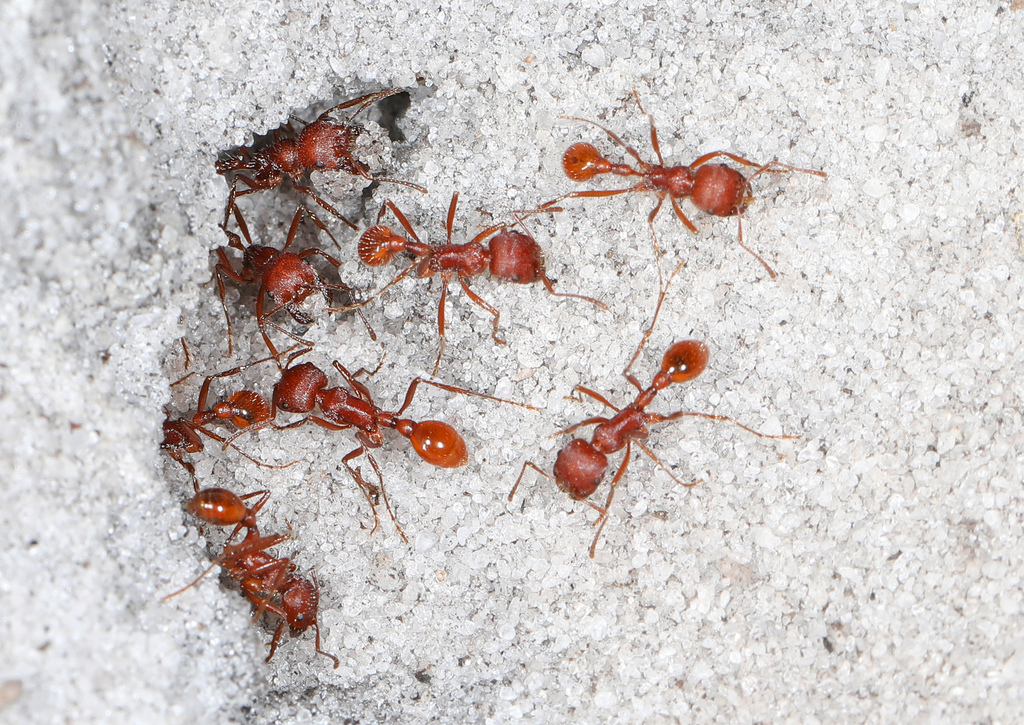
They live in well-drained sandy soils of Florida scrub, dunes and other xeric habitats on the Atlantic coastal plain. Colonies need roughly 700 workers before producing winged reproductives, with nuptial flights mainly in May-June.
Source: Wikipedia
How to recognize it
Queens, majors and intermediates have large heads; minors have narrower heads when viewed from the front. They normally lack epinotal spines on the propodeum, though occasional spines may appear.
Source: Wikipedia
Size
Minor workers are about 6.35 mm, while major workers can reach 9.52 mm, comparable to the 10-12 mm queen.
Source: Wikipedia
Does it bite or sting?
Equipped with a stinger that delivers a potent neurotoxic venom for defense against vertebrate predators. Generally docile and only sting when forced, such as when trapped against skin.
Source: Wikipedia
Where it lives
Found in Florida scrub and similar Atlantic coastal plain habitats, nesting in dry, sandy soils of xeric shrublands, grasslands, woodlands and coastal dunes.
Source: Wikipedia
What it eats
Feeds mainly on seeds and insects, harvesting grasses such as Paspalum setaceum, Dicanthelium commutatum and Croton michauxii.
Source: Wikipedia
Life cycle
Colonies become sexually mature after reaching about 700 workers, then produce winged reproductives in spring. Nuptial flights are most common from May to June, with some later flights in July.
Source: Wikipedia
When you see it
Active during the day and well adapted to hot, dry southeastern U.S. habitats.
Source: Wikipedia
Where it comes from
It is the only east-coast Pogonomyrmex species in the United States.
Source: Wikipedia
Lookalikes
It is the only polymorphic Pogonomyrmex species on the east coast and the only one in North America with that trait.
Source: Wikipedia
Where it is found in the US
Recorded in 13 of 51 states and DC. Most records: Florida, Georgia, Mississippi, South Carolina, North Carolina, Alabama, Arkansas, Kansas.
Darker = more records. Counts are museum and citizen-science records, not population size.
Source: GBIF
Status: endemic in United States. Source: iNaturalist
Months it is reported in the US
Source: GBIF
More photos


Questions people ask
Do Florida Harvester Ants bite or sting?
They can sting with a painful neurotoxic venom, but they usually only do so when trapped against the skin.
Source: Wikipedia
Where are these ants found?
In Florida scrub, coastal dunes and other dry, sandy habitats of the Atlantic coastal plain.
Source: Wikipedia
What do they eat?
Their diet is mainly seeds and insects, including grasses like Paspalum setaceum and Croton michauxii.
Source: Wikipedia
When do they have nuptial flights?
Most flights occur from May to June, with some later flights in July.
Source: Wikipedia
Same family (Formicidae)
 Eastern Black Carpenter AntCamponotus pennsylvanicusCan damage your home
 Red Imported Fire AntSolenopsis invictaCan sting
 American Winter AntPrenolepis imparis
 Argentine AntLinepithema humileNuisance, not dangerous
 Immigrant Pavement AntTetramorium immigransCan sting
 Odorous House AntTapinoma sessileCan damage your home
Sources
- Wikipedia: https://en.wikipedia.org/wiki/Pogonomyrmex_badius
Look it up elsewhere: GBIF · iNaturalist · BugGuide · ITIS · Wikipedia
Text written 2026-10-22 from the sources above and checked sentence by sentence against them. Data fetched 2026-10-22.