 Bug FAQ
Flax window-maker
Orthoclydon praefectata · Order: Lepidoptera · Family: Geometridae
Also called: Flax Looper, Flax Scraper Moth
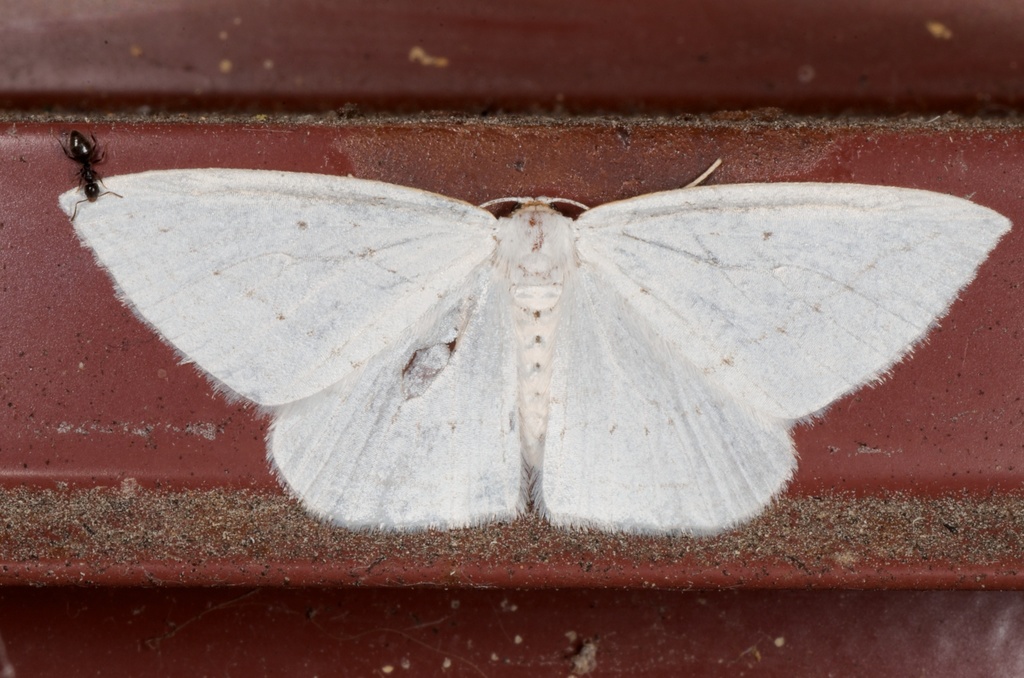
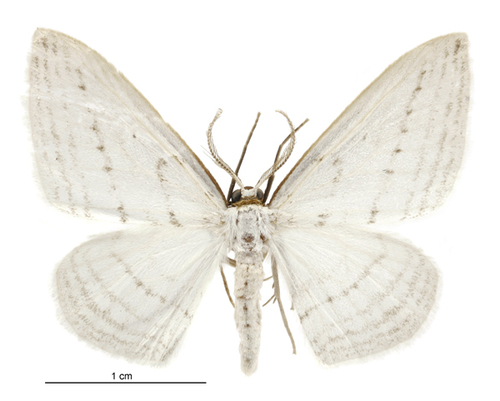
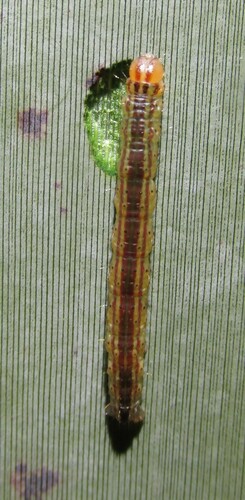
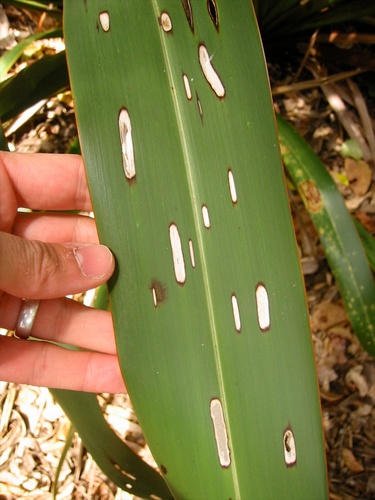
The Flax window-maker moth has a wingspan of about 38 to 45 mm and the adult male is pale brown while the female is glossy white. Its caterpillars are brown-green with three dark red lines on the back and a yellow line on each side, growing to roughly 2.5 cm long. It lives only in New Zealand, where the larvae feed on native flax (Phormium tenax) and adults are seen throughout the summer months.
Source: Wikipedia
How to recognize it
Male moths are pale brown and females are glossy white. Caterpillars are brown-green with three dark red dorsal lines and a yellow line on each flank.
Source: Wikipedia
Size
The adult’s wingspan ranges from 38 to 45 mm.
Source: Wikipedia
Where it lives
The species lives on New Zealand native flax, Phormium tenax.
Source: Wikipedia
What it eats
Caterpillars feed on the leaves of flax (Phormium tenax).
Source: Wikipedia
Life cycle
Fully grown caterpillars are about 2.5 cm long.
Source: Wikipedia
When you see it
Adult moths are observed during all summer months.
Source: Wikipedia
Where it comes from
It is endemic to New Zealand.
Source: Wikipedia
Lookalikes
It is endemic to New Zealand, so there are no similar species elsewhere.
Source: Wikipedia
More photos

Questions people ask
What do the caterpillars look like?
They are brown-green with three dark red lines on the back and a yellow line on each side.
Source: Wikipedia
When can I see adult Flax window-maker moths?
Adults are present throughout the summer months.
Source: Wikipedia
What plant do the larvae feed on?
The caterpillars eat the leaves of native flax, Phormium tenax.
Source: Wikipedia
Same family (Geometridae)
 Willow BeautyPeribatodes rhomboidaria
 Pale BeautyCampaea perlataDamages trees, gardens or crops
 Large Lace-border MothScopula limboundataDamages trees, gardens or crops
 Riband WaveIdaea aversata
 Yellow Shell MothCamptogramma bilineata
 Large Maple Spanworm MothProchoerodes lineolaDamages trees, gardens or crops
Sources
- Wikipedia: https://en.wikipedia.org/wiki/Orthoclydon_praefectata
Look it up elsewhere: GBIF · iNaturalist · BugGuide · Wikipedia
Text written 2026-10-23 from the sources above and checked sentence by sentence against them. Data fetched 2026-10-23.