 Bug FAQ
Feather-legged Lace Weaver
Uloborus plumipes · Order: Araneae · Family: Uloboridae
Also called: Featherleg Spider, Garden Centre Spider

Females grow to about 6 mm long, sometimes up to 10 mm. They live on tree trunks, dead twigs, and houseplants in warm indoor spaces like garden-centre greenhouses.
Source: Wikipedia
How to recognize it
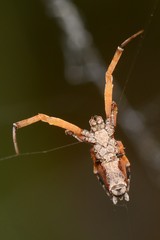
Their colour ranges from grey-brown to mottled shades with white specks. Pattern and colour can vary a lot.
Source: Wikipedia
Size
Adult females are typically about 6 mm (0.2 in) long, but can reach up to 10 mm.
Source: Wikipedia
Is it a pest in the house?
They are called garden-centre spiders because they are common on houseplants in greenhouse settings. They can be beneficial by reducing whitefly numbers.
Source: Wikipedia
Does it bite or sting?
They have no venom glands and are therefore non-venomous.
Source: Wikipedia
How to get rid of it
They are normally found on dead branches, twigs, or under house eaves.
Source: Wikipedia
Where it lives
They are found on tree trunks, dead branches, and among twigs in warm outdoor areas. In garden centres they live on houseplants in heated hothouses and can survive winter in such greenhouses.
Source: Wikipedia
What it eats
They spin fuzzy silk threads that trap prey without using glue. They may help control whitefly populations.
Source: Wikipedia
Life cycle
Eggs are hidden in silk sacs that hang from the web. Empty egg sacs are often seen attached to houseplants.
Source: Wikipedia
When you see it
First recorded in the UK in 1992, they have spread mainly in southern and eastern regions.
Source: Wikipedia
Where it comes from
Originally from warm parts of the Old World, they are now widespread there and have been introduced to Argentina and the Philippines.
Source: Wikipedia
Lookalikes
Their camouflage makes them look like dead bark or other detritus hanging from their web.
Source: Wikipedia
Where it is found in the US
Recorded in 2 of 51 states and DC. Most records: Louisiana, Alabama.
Darker = more records. Counts are museum and citizen-science records, not population size.
Source: GBIF
More photos


Same family (Uloboridae)
Sources
- Wikipedia: https://en.wikipedia.org/wiki/Uloborus_plumipes
Look it up elsewhere: GBIF · iNaturalist · BugGuide · ITIS · Wikipedia
Text written 2026-10-23 from the sources above and checked sentence by sentence against them. Data fetched 2026-10-22.