 Bug FAQ
False Crocus Geometer Moth
Xanthotype urticaria · Order: Lepidoptera · Family: Geometridae
Also called: False Crocus Geometer
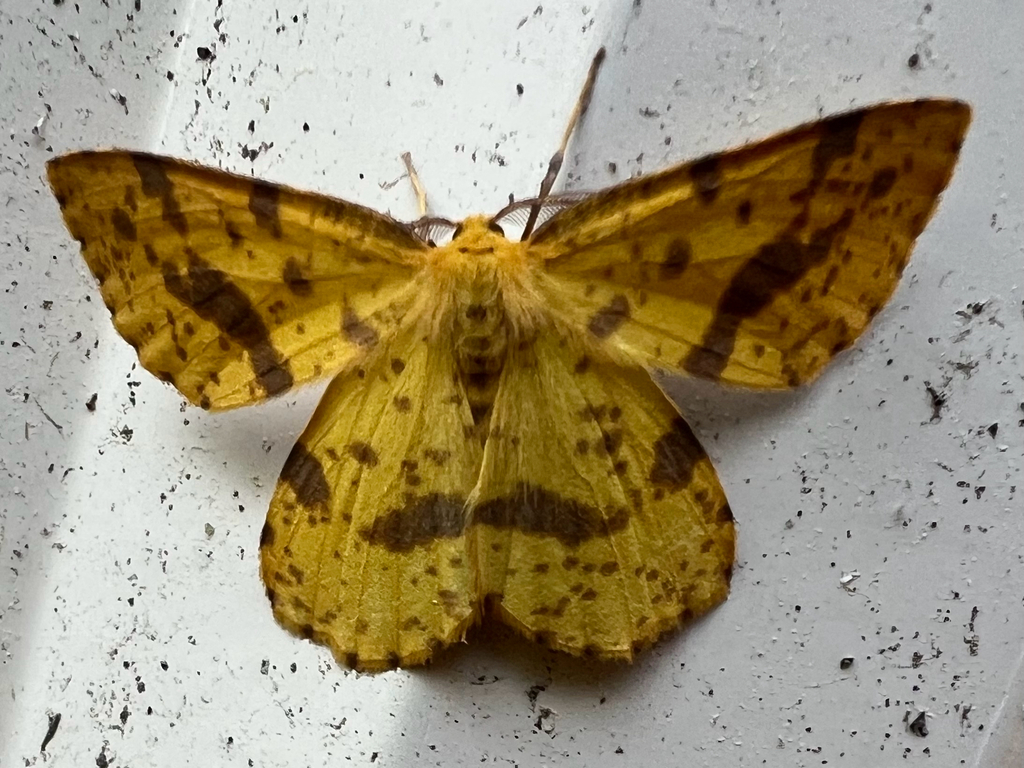
The false crocus geometer moth has a wingspan of about 3 to 4 cm and bright yellow wings marked with many brown spots, especially on males. Adults fly from May through November and feed on plants such as red osier dogwood, ground-ivy, catnip, rhodora and goldenrods. It is a North American species in the family Geometridae.
Source: Wikipedia
Size
The wingspan measures 3 to 4 cm.
Source: Wikipedia
What it eats
Adults feed on red osier dogwood (Cornus sericea). They also eat ground-ivy (Glechoma hederacea). Catnip (Nepeta spp.) is another food plant. Rhodora (Rhododendron canadense) is included in their diet. Goldenrods (Solidago spp.) are also eaten.
Source: Wikipedia
When you see it
Adults are on the wing from May to November.
Source: Wikipedia
Where it comes from
It occurs in North America.
Source: Wikipedia
Where it is found in the US
Recorded in 28 of 51 states and DC. Most records: Michigan, Massachusetts, Ohio, Minnesota, Pennsylvania, Vermont, New York, Rhode Island.
Darker = more records. Counts are museum and citizen-science records, not population size.
Source: GBIF
Status: native in North America; native in Canada. Source: iNaturalist
Months it is reported in the US
Source: GBIF
Questions people ask
What do false crocus geometer moths look like?
They have bright yellow wings with many brown spots; males have more spots than females.
Source: Wikipedia
What plants do they feed on?
They eat red osier dogwood, ground-ivy, catnip, rhodora and goldenrods.
Source: Wikipedia
Same family (Geometridae)




Sources
- Wikipedia: https://en.wikipedia.org/wiki/Xanthotype_urticaria
Look it up elsewhere: GBIF · iNaturalist · BugGuide · ITIS · Wikipedia
Text written 2026-10-24 from the sources above and checked sentence by sentence against them. Data fetched 2026-10-24.