 Bug FAQ
False bruce spanworm
Macaria loricaria · Order: Lepidoptera · Family: Geometridae
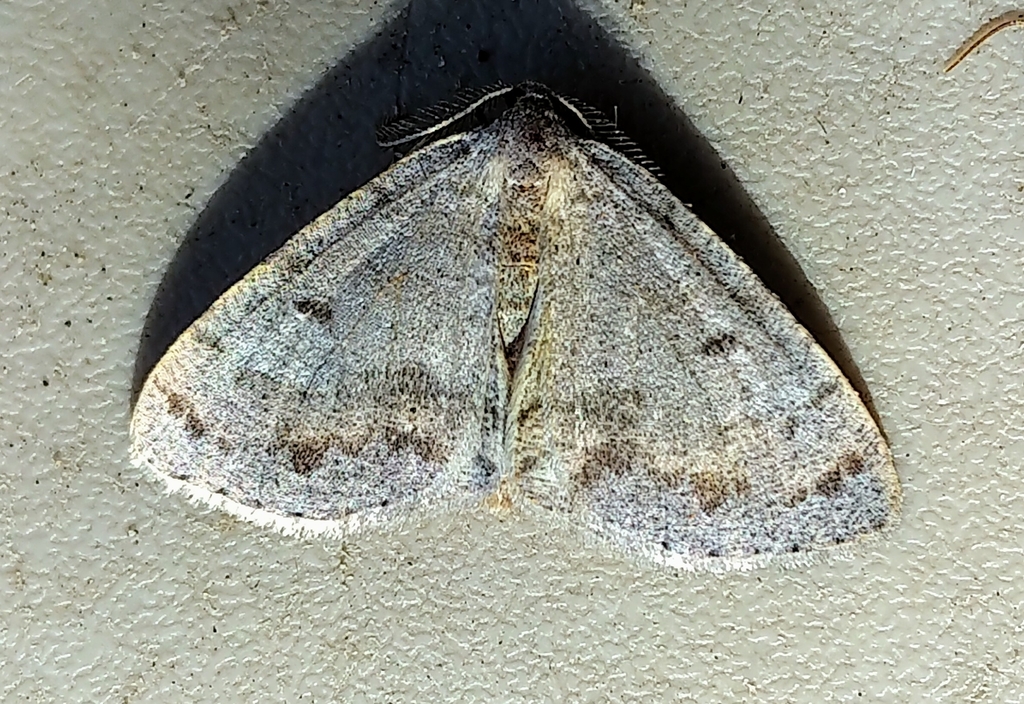
The false Bruce spanworm is a moth in the Geometridae family, known scientifically as Macaria loricaria. Males have a wingspan of about 25 to 29 mm, while females are wingless; adults fly in midsummer and the larvae feed on willow, birch and trembling aspen.
Source: Wikipedia
Size
Male moths have a wingspan of 25 to 29 mm; females do not develop wings.
Source: Wikipedia
What it eats
The caterpillars eat leaves of willow, birch and trembling aspen.
Source: Wikipedia
Life cycle
The species overwinters as an egg, and the larvae are present from May through July.
Source: Wikipedia
Where it comes from
In North America it is native from Alaska eastward to Newfoundland and New York, extending southward to Colorado.
Source: Wikipedia
Where it is found in the US
Recorded in 17 of 51 states and DC. Most records: Colorado, Michigan, Alaska, Minnesota, Montana, New Mexico, South Dakota, California.
Darker = more records. Counts are museum and citizen-science records, not population size.
Source: GBIF
Status: native in North America; native in Canada. Source: iNaturalist
Months it is reported in the US
Source: GBIF
More photos
Questions people ask
When are adult false Bruce spanworms active?
In Europe they fly from mid-July to August, while in North America they are seen from late June to late July.
Source: Wikipedia
What do the larvae eat?
The caterpillars feed on willow, birch and trembling aspen leaves.
Source: Wikipedia
Where can I find this moth?
It lives across northern Europe and Asia and throughout much of North America, from Alaska to the eastern United States and south to Colorado.
Source: Wikipedia
Same family (Geometridae)




Sources
- Wikipedia: https://en.wikipedia.org/wiki/Macaria_loricaria
Look it up elsewhere: GBIF · iNaturalist · BugGuide · ITIS · Wikipedia
Text written 2026-10-28 from the sources above and checked sentence by sentence against them. Data fetched 2026-10-28.