 Bug FAQ
European Wood Ant
Formica rufa · Order: Hymenoptera · Family: Formicidae
Also called: Red Wood Ant, Southern Red Wood Ant, Southern wood ant, Wood Ant
Source: Wikipedia
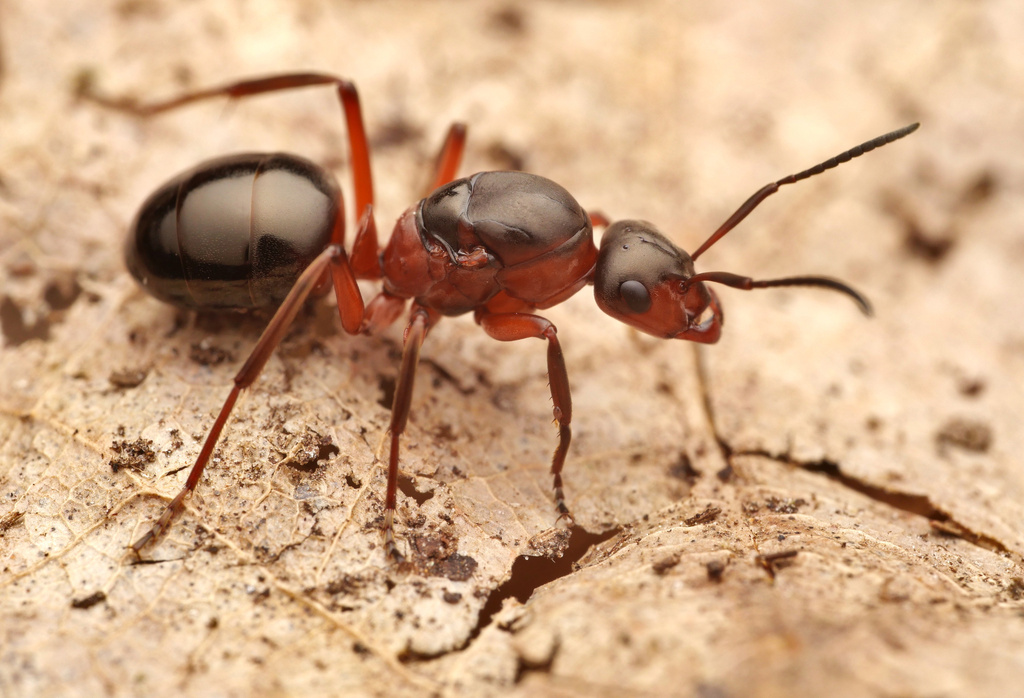
Wood ants are large, polymorphic workers 4.5 to 9 mm long with red heads and thoraces and a brownish-black abdomen. They build conspicuous dome-shaped mounds in sunny woodland clearings and are aggressively territorial, often attacking other ant species. Their diet is dominated by aphid honeydew, but they also hunt insects and arachnids and scavenge voraciously.
Source: Wikipedia
How to recognize it
The head and thorax are red, while the abdomen is brownish-black, sometimes with dark patches.
Source: Wikipedia
Size
Workers range from 4.5 to 9 mm in length.
Source: Wikipedia
Where it lives
The species is aggressively territorial and will attack and remove other ant species from the area.
Source: Wikipedia
What it eats
Adults mainly feed on honeydew produced by aphids. They also prey on insects and arachnids and act as voracious scavengers.
Source: Wikipedia
Life cycle
Nuptial flights occur in spring and are often accompanied by fierce battles between neighboring colonies as territorial boundaries are re-established. New nests are founded by budding in spring or by temporary social parasitism of species in the Formica fusca group.
Source: Wikipedia
When you see it
Nuptial flights take place during the springtime. Permanent foraging trails are reinforced each season.
Source: Wikipedia
Where it is found in the US
Recorded in 16 of 51 states and DC. Most records: Idaho, Colorado, Arizona, California, New York, Delaware, West Virginia, Oregon.
Darker = more records. Counts are museum and citizen-science records, not population size.
Source: GBIF
Months it is reported in the US
Source: GBIF
More photos


Questions people ask
Do they bite or sting?
When threatened they spray formic acid, which can cause a mild sting.
Source: Wikipedia
What do these ants eat?
Adults mainly collect honeydew from aphids, but they also hunt insects and arachnids and scavenge.
Source: Wikipedia
Same family (Formicidae)
 Eastern Black Carpenter AntCamponotus pennsylvanicusCan bite
 Red Imported Fire AntSolenopsis invictaCan sting
 American Winter AntPrenolepis imparis
 Argentine AntLinepithema humileNuisance, not dangerous
 Immigrant Pavement AntTetramorium immigransCan sting
 Odorous House AntTapinoma sessileCan damage your home
Sources
- Wikipedia: https://en.wikipedia.org/wiki/Formica_rufa
Look it up elsewhere: GBIF · iNaturalist · BugGuide · ITIS · Wikipedia
Text written 2026-10-29 from the sources above and checked sentence by sentence against them. Data fetched 2026-10-29.