 Bug FAQ
European fire ant
Myrmica rubra · Order: Hymenoptera · Family: Formicidae
Also called: Red Ant
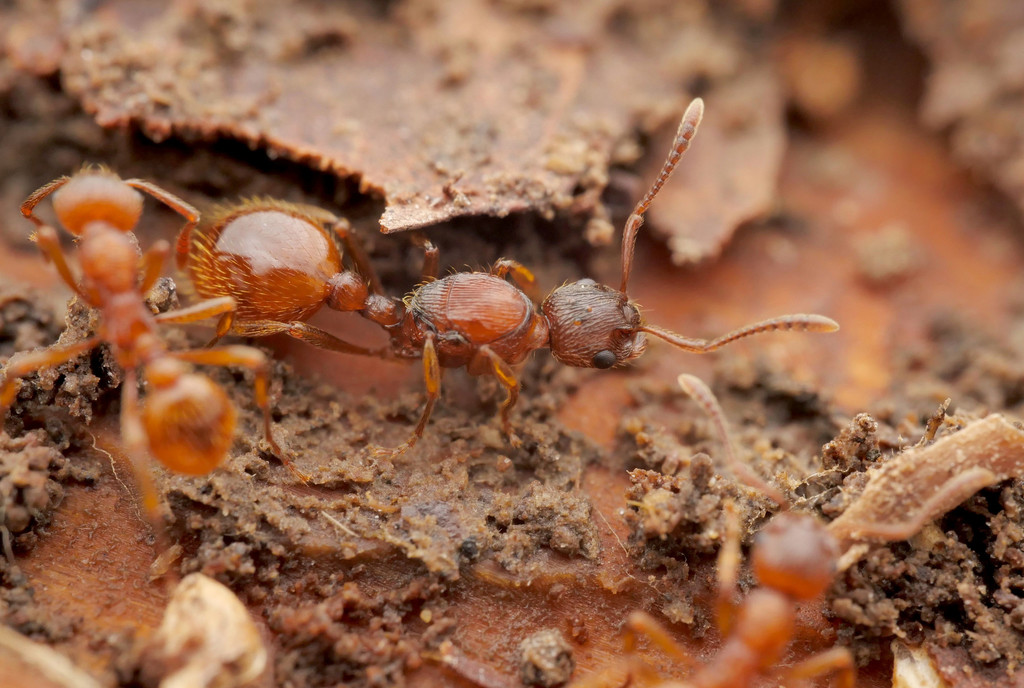
Workers are yellow-brown, 3.5 to 5.5 mm long, with a smooth shiny head and long antennae. Queens are larger, 5.5 to 7 mm, with a bigger thorax for wing muscles. They live under stones, fallen trees, and in soil in meadows and gardens across Europe and the UK.
Source: Wikipedia
How to recognize it
The ant is mainly red with a slightly darker head.
Source: Wikipedia
Size
Workers measure 3.5 to 5.5 mm; queens 5.5 to 7 mm.
Source: Wikipedia
Does it bite or sting?
Will attack if the nest is disturbed but are less aggressive than red imported fire ants.
Source: Wikipedia
How to get rid of it
A nematode may cause colony collapse, suggesting a possible control method. Larvae of Alcon blue and scarce large blue butterflies use this ant as their primary host.
Source: Wikipedia
Where it lives
Found under stones, fallen logs, and in soil; common in European meadows and gardens.
Source: Wikipedia
What it eats
Feeds on honeydew from aphids, other insects, invertebrates, and pollen.
Source: Wikipedia
Life cycle
Queens can live up to fifteen years. Nuptial flights occur late July to mid-August in Europe; after mating, males die and queens shed wings.
Source: Wikipedia
When you see it
No flights observed in North America, though male swarms have been noted in Newfoundland.
Source: Wikipedia
Where it comes from
Native across Europe from Portugal to East Siberia and north to the forest-tundra zone. Now invasive in parts of North America and Asia.
Source: Wikipedia
Lookalikes
A reproductive morph, M. microrubra, was once thought to be a social parasite.
Source: Wikipedia
Where it is found in the US
Recorded in 12 of 51 states and DC. Most records: Massachusetts, New York, Maine, Washington, Rhode Island, Vermont, Illinois, Michigan.
Darker = more records. Counts are museum and citizen-science records, not population size.
Source: GBIF
Status: introduced in Canada; introduced in United States. Source: iNaturalist
Months it is reported in the US
Source: GBIF
More photos



Questions people ask
Do they bite or sting people?
They may bite if their nest is disturbed, but they are not noted as a serious threat to humans.
Source: Wikipedia
Where can I find these ants?
Look under stones, fallen logs, and in soil of meadows and gardens throughout Europe and the UK.
Source: Wikipedia
How can I control them?
Research suggests a specific nematode might collapse colonies, offering a potential control option.
Source: Wikipedia
Same family (Formicidae)
 Eastern Black Carpenter AntCamponotus pennsylvanicusCan damage your home
 Red Imported Fire AntSolenopsis invictaCan sting
 American Winter AntPrenolepis imparis
 Argentine AntLinepithema humileNuisance, not dangerous
 Immigrant Pavement AntTetramorium immigransCan sting
 Odorous House AntTapinoma sessileCan damage your home
Sources
- Wikipedia: https://en.wikipedia.org/wiki/Myrmica_rubra
Look it up elsewhere: GBIF · iNaturalist · BugGuide · ITIS · Wikipedia
Text written 2026-10-22 from the sources above and checked sentence by sentence against them. Data fetched 2026-10-22.