 Bug FAQ
Eurasian Smoothwing
Scaeva pyrastri · Order: Diptera · Family: Syrphidae
Also called: Pied Hover Fly

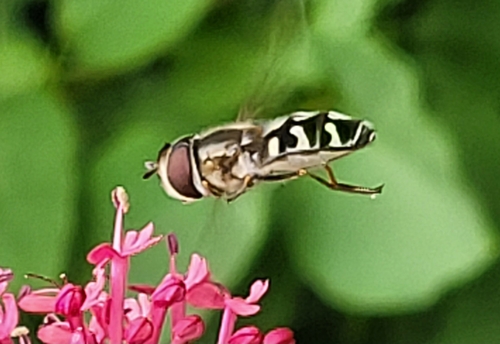
Adult smoothwings are medium-sized flies about 11 to 15 mm long and have three white comma-shaped spots on their abdomen and a yellow face with reddish-brown antennae. They live in gardens, meadows and wasteland, visit many flowers, and their larvae eat aphids, often consuming hundreds per development.
Source: Wikipedia
How to recognize it
The abdomen shows three pairs of white lunules; a similar species, Scaeva selenitica, has yellow markings instead. The face is yellow and the antennae are reddish brown.
Source: Wikipedia
Size
Length ranges from 11 to 15 mm (0.43 to 0.59 in).
Source: Wikipedia
Where it lives
Found in gardens, meadows and wasteland. Adults often visit Apiaceae flowers as well as rape, honeysuckle and daisies.
Source: Wikipedia
What it eats
Larvae feed on various aphid species, sometimes eating more than 500 aphids during development.
Source: Wikipedia
Life cycle
Larvae are light green or pink with a white dorsal stripe.
Source: Wikipedia
When you see it
Adults fly from April to September, peaking in July and August.
Source: Wikipedia
Where it comes from
Present across most of Europe, the Near East, East Palearctic, Nearctic, North Africa and the Indomalayan region.
Source: Wikipedia
Lookalikes
Scaeva selenitica looks similar but has yellow abdominal lunules instead of white.
Source: Wikipedia
Where it is found in the US
Recorded in 12 of 51 states and DC. Most records: California, Arizona, Oregon, Colorado, Washington, Alaska, New Mexico, Idaho.
Darker = more records. Counts are museum and citizen-science records, not population size.
Source: GBIF
Months it is reported in the US
Source: GBIF
More photos
Questions people ask
Are they a garden pest?
No, the larvae actually help by eating aphids that can damage plants.
Source: Wikipedia
Same family (Syrphidae)






Sources
- Wikipedia: https://en.wikipedia.org/wiki/Scaeva_pyrastri
Look it up elsewhere: GBIF · iNaturalist · BugGuide · ITIS · Wikipedia
Text written 2026-10-22 from the sources above and checked sentence by sentence against them. Data fetched 2026-10-22.