 Bug FAQ
Eudonia octophora
Eudonia octophora · Order: Lepidoptera · Family: Crambidae

Adults measure about 22 to 24 mm in length. The moth has brownish-ochreous head and thorax with dark speckles, and its forewings are elongate, triangular and patterned with dark fuscous lines, a distinctive 8-shaped reniform spot and a whitish second line. It lives in wetland areas where rushes (Juncus) grow, and the larvae feed on Juncus species. Adults are on the wing from October through May and are attracted to light.
Source: Wikipedia
How to recognize it
The head and thorax are brownish-ochreous with dark speckles, and the forewings are elongate, triangular, brownish-ochreous with dark fuscous irrorations, a faint pale first line, a dark 8-shaped reniform spot, a distinct whitish second line, and a row of black clots along the hind margin.
Source: Wikipedia
Size
Adults are 22 to 24 mm long.
Source: Wikipedia
Where it lives
It inhabits wetlands where rushes are present. Larval host plants are species of the genus Juncus.
Source: Wikipedia
What it eats
Larvae feed on Juncus species.
Source: Wikipedia
Life cycle
Adults are attracted to light and are commonly caught in mercury-vapour light traps.
Source: Wikipedia
When you see it
Adults are on the wing from October to May.
Source: Wikipedia
Where it comes from
Eudonia octophora is endemic to New Zealand and has been recorded on the North Island, South Island and the Chatham Islands.
Source: Wikipedia
More photos
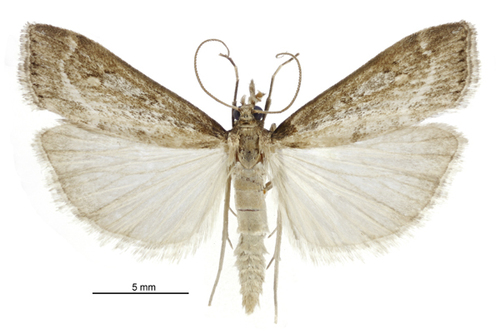
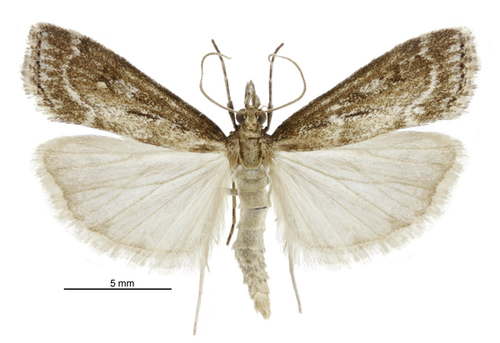
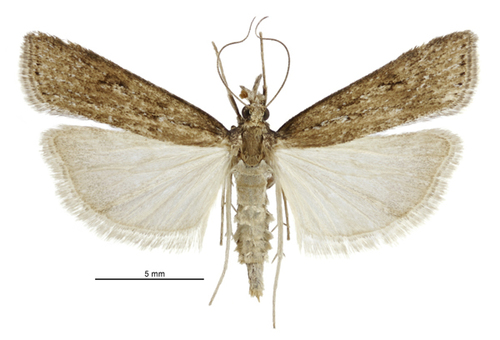
Questions people ask
Where can I find this species?
It lives in wetland areas with rushes and is endemic to New Zealand, occurring on both main islands and the Chatham Islands.
Source: Wikipedia
Same family (Crambidae)
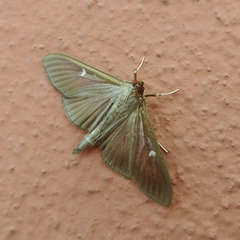 Box Tree MothCydalima perspectalisDamages trees, gardens or crops
 Celery Leaftier MothUdea rubigalisDamages trees, gardens or crops
 Elegant Grass-veneerMicrocrambus elegans
 Hawaiian Beet Webworm MothSpoladea recurvalisDamages trees, gardens or crops
 Garden Grass-veneerChrysoteuchia culmellaDamages trees, gardens or crops
 Bluegrass Webworm MothParapediasia teterrellusDamages trees, gardens or crops
Sources
- Wikipedia: https://en.wikipedia.org/wiki/Eudonia_octophora
Look it up elsewhere: GBIF · iNaturalist · BugGuide · Wikipedia
Text written 2026-10-23 from the sources above and checked sentence by sentence against them. Data fetched 2026-10-23.