 Bug FAQ
Elbow-striped Grass-veneer
Agriphila geniculea · Order: Lepidoptera · Family: Crambidae
Also called: Elbow-stripe Grass-veneer
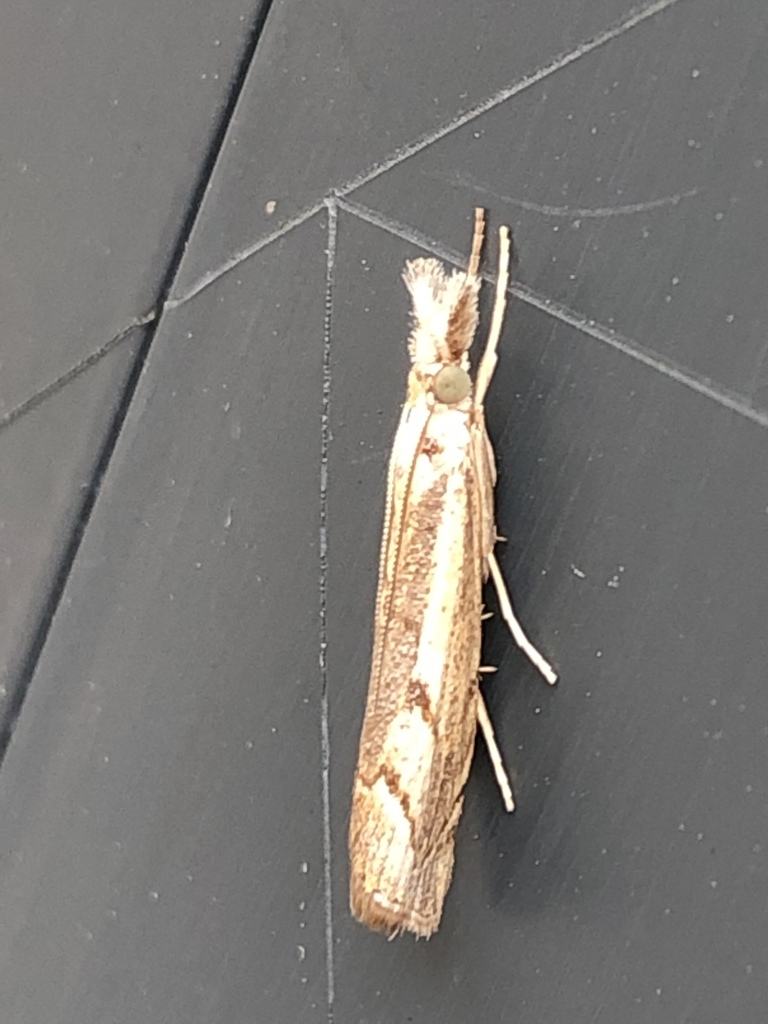
The elbow-striped grass-veneer is a small moth with a wingspan of about 20 to 26 mm. Adults fly at dusk from July to October, while the larvae live inside grass stems from late September through early May.
Source: Wikipedia
How to recognize it
The forewings normally show two strongly curved cross-lines, though they can sometimes be faint or missing. Two chevron-shaped marks cross the forewings, which helps separate it from the similar Agriphila inquinatella that has variable longitudinal streaks.
Source: Wikipedia
Size
Wingspan ranges from 20 to 26 mm.
Source: Wikipedia
Where it lives
Found in dry pastures, grassy areas, sand-dunes, gardens and other grasslands.
Source: Wikipedia
What it eats
Larvae feed inside stems of fine fescue (Festuca ovina) and other grass species.
Source: Wikipedia
Life cycle
The species produces one generation per year. Larvae are present from late September to early May, overwintering as larvae.
Source: Wikipedia
When you see it
Adults are active at dusk from July through October, depending on location.
Source: Wikipedia
Where it comes from
Occurs throughout most of Europe and in parts of North Africa.
Source: Wikipedia
Where it is found in the US
Recorded in 1 of 51 states and DC. Most records: California.
Darker = more records. Counts are museum and citizen-science records, not population size.
Source: GBIF
Months it is reported in the US
Source: GBIF
Same family (Crambidae)
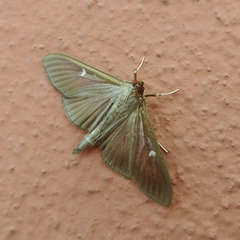 Box Tree MothCydalima perspectalisDamages trees, gardens or crops
 Celery Leaftier MothUdea rubigalisDamages trees, gardens or crops
 Elegant Grass-veneerMicrocrambus elegans
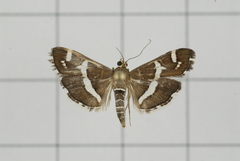 Hawaiian Beet Webworm MothSpoladea recurvalisDamages trees, gardens or crops
 Garden Grass-veneerChrysoteuchia culmellaDamages trees, gardens or crops
 Bluegrass Webworm MothParapediasia teterrellusDamages trees, gardens or crops
Sources
- Wikipedia: https://en.wikipedia.org/wiki/Agriphila_geniculea
Look it up elsewhere: GBIF · iNaturalist · BugGuide · Wikipedia
Text written 2026-10-22 from the sources above and checked sentence by sentence against them. Data fetched 2026-10-22.