 Bug FAQ
Drugstore Beetle
Stegobium paniceum · Order: Coleoptera · Family: Anobiidae
Also called: Bread beetle, Drug-store Beetle, biscuit beetle
Source: Wikipedia

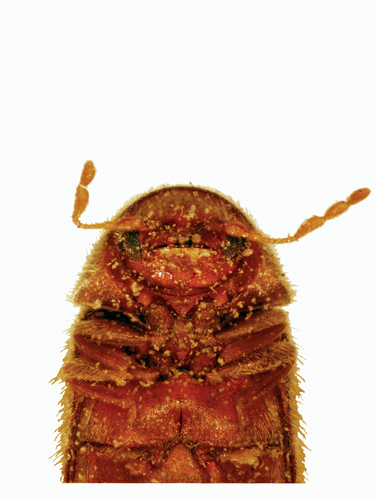
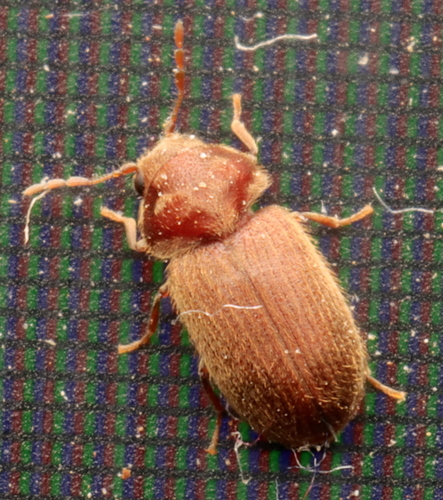
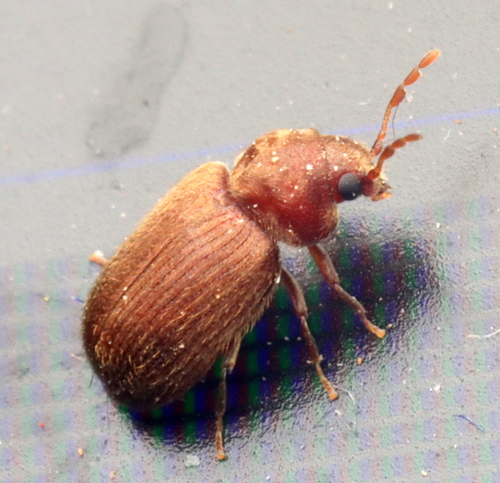
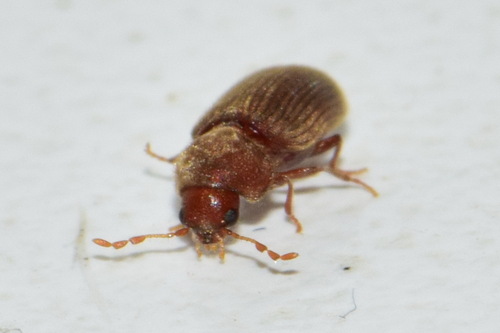
Adult drugstore beetles are tiny, reddish-brown insects about 2.5 to 3.5 mm long with club-ended antennae and grooved wing covers. They thrive worldwide, especially in warm areas, and get into homes on bulk dry goods where the larvae feed on a wide range of pantry items. Finding and removing the infested product, or freezing it below to 20 °C, is the most reliable way to stop an infestation.
Source: Wikipedia
How to recognize it
Adults have antennae that end in a three-segment club, unlike the saw-toothed antennae of cigarette beetles. Their wing covers have longitudinal grooves, while cigarette beetles have smooth elytra.
Source: Wikipedia
Size
They measure between 2.5 and 3.5 mm in length.
Source: Wikipedia
How to get rid of it
The best control is to locate and discard the infested source. Freezing the items below to 20 °C also kills all life stages.
Source: Wikipedia
Where it lives
The species is found worldwide, especially in warmer climates.
Source: Wikipedia
What it eats
Larvae eat bread, grains, coffee, powdered milk, sweets, spices, dried fruit, seeds and similar dry foods. Most damage occurs during the larval stage.
Source: Wikipedia
Life cycle
They develop from egg to adult through 4 to 6 larval stages, a cocooned pupa, then emerge as adults. Under optimal conditions, an egg becomes an adult in about 40 days.
Source: Wikipedia
Where it comes from
Their distribution is global with higher numbers in hot regions.
Source: Wikipedia
Lookalikes
They are frequently mistaken for cigarette beetles because of similar size and colour.
Source: Wikipedia
Where it is found in the US
Recorded in 30 of 51 states and DC. Most records: Texas, Alaska, California, Florida, Michigan, Indiana, Pennsylvania, Illinois.
Darker = more records. Counts are museum and citizen-science records, not population size.
Source: GBIF
Months it is reported in the US
Source: GBIF
More photos
Questions people ask
How can I get rid of a drugstore beetle infestation?
Find and throw away any contaminated food, or freeze it below to 20 °C to kill the insects.
Source: Wikipedia
What foods do they damage?
They feed on a wide range of dry pantry items such as bread, grains, coffee, powdered milk, sweets, spices, dried fruit and seeds.
Source: Wikipedia
How can I tell if it’s a drugstore beetle or a cigarette beetle?
Drugstore beetles have club-ended antennae and grooved wing covers, while cigarette beetles have saw-toothed antennae and smooth elytra.
Source: Wikipedia
Same family (Anobiidae)


Sources
- Wikipedia: https://en.wikipedia.org/wiki/Drugstore_beetle
Look it up elsewhere: GBIF · iNaturalist · BugGuide · ITIS · Wikipedia
Text written 2026-10-22 from the sources above and checked sentence by sentence against them. Data fetched 2026-10-22.