 Bug FAQ
Double-striped Pug
Gymnoscelis rufifasciata · Order: Lepidoptera · Family: Geometridae
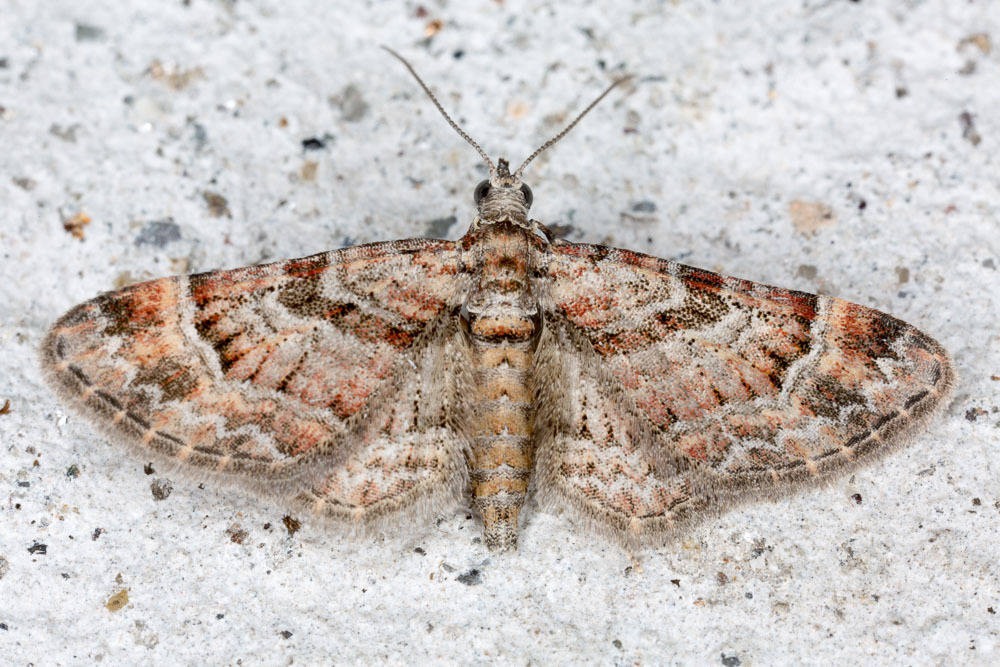
The double-striped pug is a small night-flying moth with a wingspan of about 1.5 to 1.9 cm and caterpillars up to 1.7 cm long. It is common across the Palearctic, Near East and North Africa, attracted to light and flowers. Adults appear in two or three broods from spring through autumn; later broods are darker.
Source: Wikipedia
How to recognize it
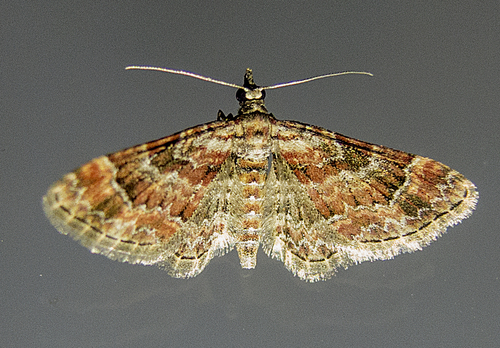
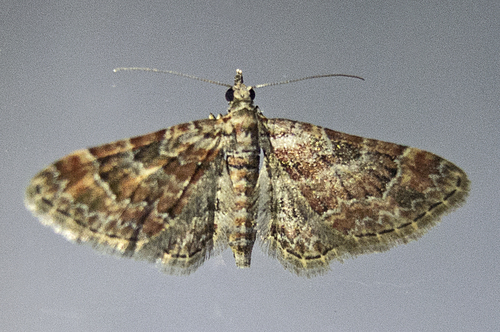
Two dark bands cross each forewing, giving the species its name. Forewings range from light to dark reddish-brown with distinct crosslines and a pale white sub-marginal line marked with black; hindwings are pale grey with darker fringes and a small black discal spot, plus a dark band on the abdomen base.
Source: Wikipedia
Size
Wingspan is 15 to 19 mm. Caterpillars grow up to 17 mm long.
Source: Wikipedia
Where it lives
Active at night and attracted to lights and flowers.
Source: Wikipedia
What it eats
Larvae feed on the flowers of many plant species and may also eat other lepidopteran larvae.
Source: Wikipedia
Life cycle
Two or three generations are produced each year, with adults flying in spring, midsummer and sometimes autumn. The species overwinters as a pupa.
Source: Wikipedia
When you see it
Adults are on the wing in April-May, July-August, and sometimes later in autumn. Later broods tend to have darker markings.
Source: Wikipedia
Where it comes from
Its range covers the entire Palearctic, Near East and North Africa.
Source: Wikipedia
More photos
Same family (Geometridae)
 Willow BeautyPeribatodes rhomboidaria
 Pale BeautyCampaea perlataDamages trees, gardens or crops
 Large Lace-border MothScopula limboundataDamages trees, gardens or crops
 Riband WaveIdaea aversata
 Yellow Shell MothCamptogramma bilineata
 Large Maple Spanworm MothProchoerodes lineolaDamages trees, gardens or crops
Sources
- Wikipedia: https://en.wikipedia.org/wiki/Double-striped_pug
Look it up elsewhere: GBIF · iNaturalist · BugGuide · ITIS · Wikipedia
Text written 2026-10-22 from the sources above and checked sentence by sentence against them. Data fetched 2026-10-22.