 Bug FAQ
Double Square-spot
Xestia triangulum · Order: Lepidoptera · Family: Noctuidae
Also called: Square-spotted Clay

The Double Square-spot moth has a wingspan of about 36 to 46 mm. Its forewings are pale brown with two distinctive black marks and a rufous-tinged grey-brown colour, while the hindwings are dark brown.
Source: Wikipedia
How to recognize it
The forewings are pale brown with two black spots and a small basal blotch, a pre-apical costal spot, and a dark cell; hindwings are fuscous.
Source: Wikipedia
Size
Wingspan ranges from 36 to 46 mm (1.4 to 1.8 in).
Source: Wikipedia
Where it lives
Found mainly on forest edges, shrub-covered slopes, heaths, gardens and parkland.
Source: Wikipedia
Life cycle
The species overwinters in the larval stage.
Source: Wikipedia
Where it comes from
Distributed across most of Europe, except Mediterranean islands and the far north of Fennoscandia. Its eastern range extends across the Palearctic to Siberia and south-east to the Black Sea and Iran.
Source: Wikipedia
Lookalikes
It closely resembles Xestia ditrapezium, which has a slightly narrower (or longer) forewing.
Source: Wikipedia
Questions people ask
How can I tell the Double Square-spot apart from similar moths?
Look for the two black marks on the pale brown forewings and the darker cell area; Xestia ditrapezium usually has a narrower forewing.
Source: Wikipedia
When are Double Square-spot moths active?
They fly at night during June and July in the British Isles.
Source: Wikipedia
Same family (Noctuidae)
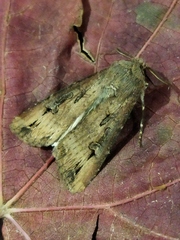 Ipsilon Dart MothAgrotis ipsilonDamages trees, gardens or crops
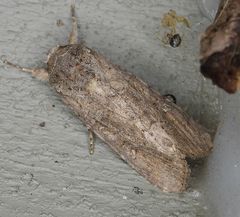 Fall Armyworm MothSpodoptera frugiperdaDamages trees, gardens or crops
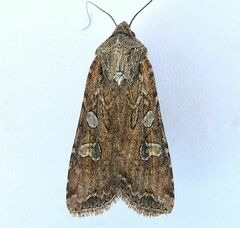 Army Cutworm MothEuxoa auxiliarisDamages trees, gardens or crops
 Large Yellow UnderwingNoctua pronubaDamages trees, gardens or crops
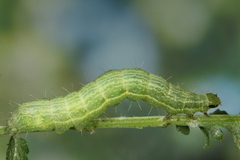 Silver ΥAutographa gamma
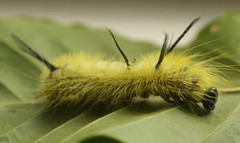 American DaggerAcronicta americanaCan irritate skin
Sources
- Wikipedia: https://en.wikipedia.org/wiki/Double_square-spot
Look it up elsewhere: GBIF · iNaturalist · BugGuide · Wikipedia
Text written 2026-10-22 from the sources above and checked sentence by sentence against them. Data fetched 2026-10-22.