 Bug FAQ
Double-banded Grass-veneer
Crambus agitatellus · Order: Lepidoptera · Family: Crambidae
Also called: Double-banded Grass-veneer Moth
Source: Wikipedia

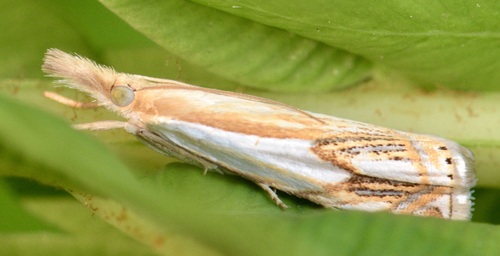
Adult double-banded grass-veneers are small moths with a wingspan of about 1.7 to 2.2 cm. Their forewings show a wide white stripe that tapers at both ends, with several black lines leading to a yellow-orange band near the wing edge. They are common in open grassy places across the eastern U.S. and southeastern Canada, and adults fly from June through August.
Source: Wikipedia
How to recognize it
The forewings have a broad white stripe that narrows at each end. Four or five black lines run from the stripe to a yellow-orange horizontal line near the wing tip.
Source: Wikipedia
Size
Adults have a wingspan of roughly 17 to 22 mm.
Source: Wikipedia
When you see it
Adults are active from June through August.
Source: Wikipedia
Where it is found in the US
Recorded in 38 of 51 states and DC. Most records: Maryland, Pennsylvania, New York, Vermont, Massachusetts, Ohio, North Carolina, Virginia.
Darker = more records. Counts are museum and citizen-science records, not population size.
Source: GBIF
Status: native in North America; native in Canada; native in United States. Source: iNaturalist
Months it is reported in the US
Source: GBIF
More photos
Questions people ask
Can they damage my garden?
The larvae can feed on grasses and low-growing garden plants, potentially causing damage.
Source: Wikipedia
Same family (Crambidae)
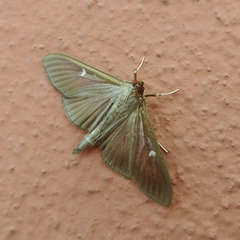 Box Tree MothCydalima perspectalisDamages trees, gardens or crops
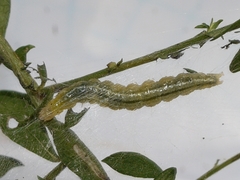 Celery Leaftier MothUdea rubigalisDamages trees, gardens or crops
 Elegant Grass-veneerMicrocrambus elegans
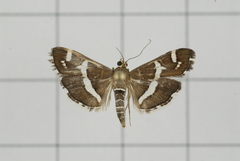 Hawaiian Beet Webworm MothSpoladea recurvalisDamages trees, gardens or crops
 Garden Grass-veneerChrysoteuchia culmellaDamages trees, gardens or crops
 Bluegrass Webworm MothParapediasia teterrellusDamages trees, gardens or crops
Sources
- Wikipedia: https://en.wikipedia.org/wiki/Crambus_agitatellus
Look it up elsewhere: GBIF · iNaturalist · BugGuide · Wikipedia
Text written 2026-10-22 from the sources above and checked sentence by sentence against them. Data fetched 2026-10-22.