 Bug FAQ
Dot-lined Angle
Macaria abydata · Order: Lepidoptera · Family: Geometridae
Source: Wikipedia


The dot-lined angle has a wingspan of about 22 to 27 mm. Small dots line the postmedial (and sometimes median) lines on both fore- and hind-wings. It is native from northern Argentina through the Caribbean up into the southern United States, and it has spread to the Pacific region.
Source: Wikipedia
How to recognize it
The name “dot-lined” refers to tiny dots along the postmedial and sometimes median lines of both fore- and hind-wings.
Source: Wikipedia
Size
Adults have a wingspan ranging from 22 to 27 mm (0.87 to 1.06 in).
Source: Wikipedia
Where it lives
In its native range it lives from northern Argentina through the Caribbean and the southern United States, often wandering northward to states like Colorado and Kentucky.
Source: Wikipedia
What it eats
Larvae feed on several legume plants including Vachellia farnesiana, Cassia, Sesbania, Parkinsonia aculeata, and soybean (Glycine max). In Hawaii they have also been found on Acacia koa, introduced Lysiloma latisiliquum, and lychee (Litchi chinensis).
Source: Wikipedia
Where it comes from
It is native to northern Argentina, the Caribbean, and the southern United States.
Source: Wikipedia
Where it is found in the US
Recorded in 21 of 51 states and DC. Most records: Texas, Hawaii, Arizona, California, Florida, Oklahoma, Louisiana, Missouri.
Darker = more records. Counts are museum and citizen-science records, not population size.
Source: GBIF
Months it is reported in the US
Source: GBIF
More photos


Questions people ask
What do the dots on its wings look like?
Small dots run along the postmedial (and sometimes median) lines of both fore- and hind-wings.
Source: Wikipedia
What plants do the caterpillars eat?
They eat legumes such as Vachellia farnesiana, Cassia, Sesbania, Parkinsonia aculeata, and soybean, and in Hawaii also Acacia koa, Lysiloma latisiliquum, and lychee.
Source: Wikipedia
Where is this moth originally from?
It is native to northern Argentina, the Caribbean, and the southern United States.
Source: Wikipedia
Same family (Geometridae)
 Willow BeautyPeribatodes rhomboidaria
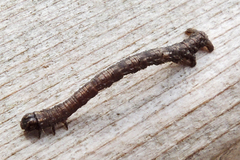 Pale BeautyCampaea perlataDamages trees, gardens or crops
 Large Lace-border MothScopula limboundataDamages trees, gardens or crops
 Riband WaveIdaea aversata
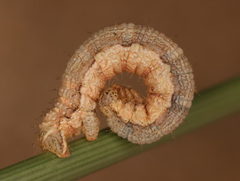 Yellow Shell MothCamptogramma bilineata
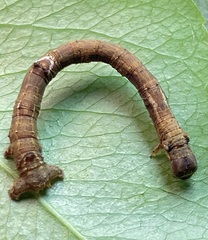 Large Maple Spanworm MothProchoerodes lineolaDamages trees, gardens or crops
Sources
- Wikipedia: https://en.wikipedia.org/wiki/Macaria_abydata
Look it up elsewhere: GBIF · iNaturalist · BugGuide · Wikipedia
Text written 2026-10-23 from the sources above and checked sentence by sentence against them. Data fetched 2026-10-23.