 Bug FAQ
Destroyer Ant
Trichomyrmex destructor · Order: Hymenoptera · Family: Formicidae
Also called: Destructive trailing ant, Singapore ant
Source: Wikipedia

Workers are 1.8 to 3.5 mm long, have a square head, 12-segmented club-tipped antennae and a smooth shiny body with erect hairs. Colonies live in soil, trees or heated buildings and are polygyne, meaning they have several queens. They forage for almost any food in homes, especially soybean oil, white bread and peanut butter, and will chew through fabric, rubber, plastic and electrical insulation.
Source: Wikipedia
How to recognize it
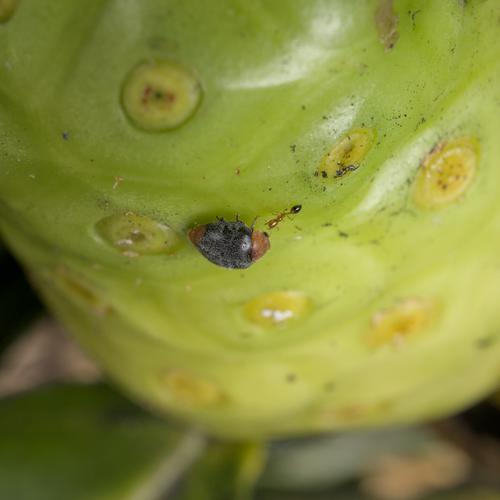
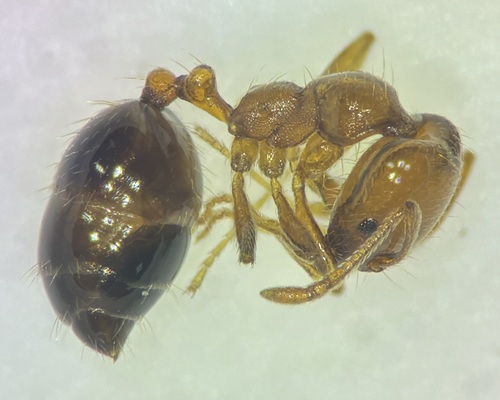
The ant has a square head and 12-segment antennae that end in club-like tips. Its body is mostly smooth and shiny with upright hairs.
Source: Wikipedia
Size
Workers range from 1.8 to 3.5 mm in length. Queens are slightly larger, about 3 to 4 mm long.
Source: Wikipedia
Does it bite or sting?
The ants sometimes attack living animals and people, giving painful bites.
Source: Wikipedia
How to get rid of it
The ant spread early by sea travel, infesting ships and bothering steamer passengers by 1922.
Source: Wikipedia
Where it lives
Colonies can be found in trees, soil or inside buildings. In cooler regions they often nest in heated structures.
Source: Wikipedia
What it eats
It eats a wide range of foods, including live and dead insects, eggs, nectar, seeds and almost any household food item. In bait tests it prefers soybean oil, white bread and especially peanut butter over honey.
Source: Wikipedia
Life cycle
Colonies have multiple queens (polygyne).
Source: Wikipedia
When you see it
Workers forage slowly in narrow trails.
Source: Wikipedia
Where it comes from
Its original range is unknown, but it may have originated in India, other parts of Asia, or Africa.
Source: Wikipedia
Where it is found in the US
Recorded in 4 of 51 states and DC. Most records: Hawaii, Texas, Florida, New York.
Darker = more records. Counts are museum and citizen-science records, not population size.
Source: GBIF
Status: introduced in North America. Source: iNaturalist
Months it is reported in the US
Source: GBIF
More photos


Questions people ask
Do they bite people?
Yes, they can give painful bites that may even knock a person unconscious for a short time.
Source: Wikipedia
What damage can they cause in a house?
They chew through fabrics, rubber, plastic and electrical wiring, which can damage clothing, cables and equipment.
Source: Wikipedia
Where are they likely to nest in my home?
In cooler climates they often establish colonies in heated parts of buildings.
Source: Wikipedia
How can I recognize this ant?
Look for a small ant with a square head, 12-segment club-tipped antennae and a smooth shiny body with upright hairs.
Source: Wikipedia
Same family (Formicidae)
 Eastern Black Carpenter AntCamponotus pennsylvanicusCan damage your home
 Red Imported Fire AntSolenopsis invictaCan sting
 American Winter AntPrenolepis imparis
 Argentine AntLinepithema humileNuisance, not dangerous
 Immigrant Pavement AntTetramorium immigransCan sting
 Odorous House AntTapinoma sessileCan damage your home
Sources
- Wikipedia: https://en.wikipedia.org/wiki/Trichomyrmex_destructor
Look it up elsewhere: GBIF · iNaturalist · BugGuide · ITIS · Wikipedia
Text written 2026-10-23 from the sources above and checked sentence by sentence against them. Data fetched 2026-10-22.