 Bug FAQ
Desert Orangetip
Anthocharis cethura · Order: Lepidoptera · Family: Pieridae
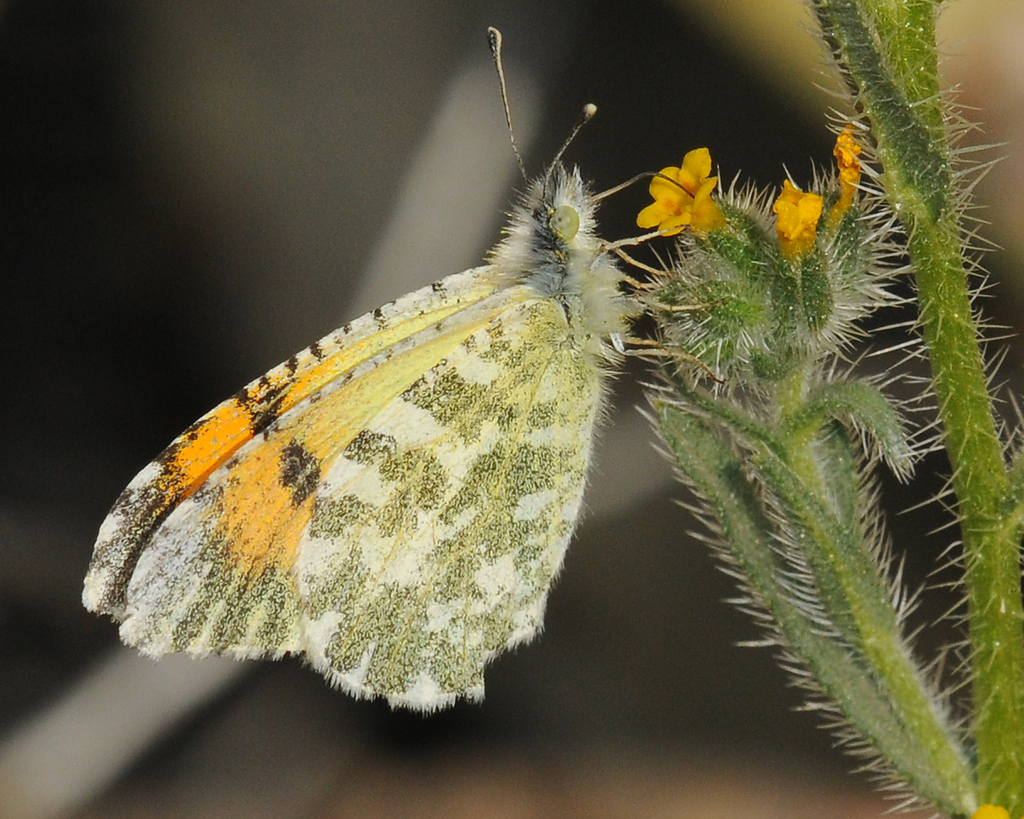
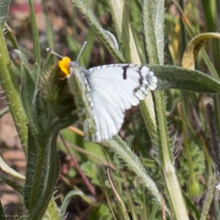
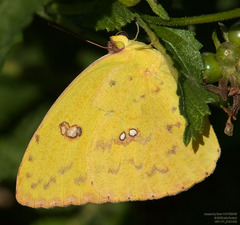
The Desert Orangetip is a small butterfly with a wingspan of about 2.6 to 4 cm (1 to 1½ in). Its forewings are yellow with an orange patch near the front, edged in black and white, and the wing edges have black spots; the underside of the hindwing shows greenish bands. It lives on rocky desert hills and ridges in the southwestern United States and northern Mexico, and the caterpillars feed on several mustard-family plants.
Source: Wikipedia
How to recognize it
The wing edges are dotted with black spots.
Source: Wikipedia
Size
Wingspan ranges from 2.6 to 4 cm (about 1 to 1½ in).
Source: Wikipedia
Where it lives
Found on hills and ridges in rocky desert areas.
Source: Wikipedia
What it eats
Caterpillars feed mainly on mustard-family plants such as lyreleaf jewelflower, London rocket, western tansymustard, sand fringepod, and California mustard.
Source: Wikipedia
Life cycle
Females lay single, conical eggs on host plants; the eggs start blue-green and later turn orange.
Source: Wikipedia
When you see it
Adults appear early in the spring.
Source: Wikipedia
Where it is found in the US
Recorded in 10 of 51 states and DC. Most records: California, Arizona, New Mexico, Nevada, Utah, Texas, Colorado, Washington.
Darker = more records. Counts are museum and citizen-science records, not population size.
Source: GBIF
Status: native in North America; native in United States. Source: iNaturalist
Months it is reported in the US
Source: GBIF
More photos
Same family (Pieridae)


Sources
- Wikipedia: https://en.wikipedia.org/wiki/Anthocharis_cethura
Look it up elsewhere: GBIF · iNaturalist · BugGuide · ITIS · Wikipedia
Text written 2026-10-23 from the sources above and checked sentence by sentence against them. Data fetched 2026-10-23.