 Bug FAQ
Dark Rover Ant
Brachymyrmex patagonicus · Order: Hymenoptera · Family: Formicidae
Source: Wikipedia

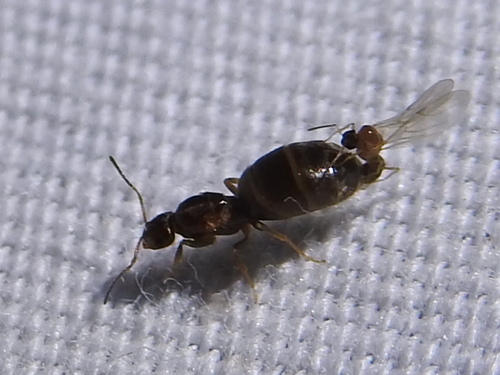
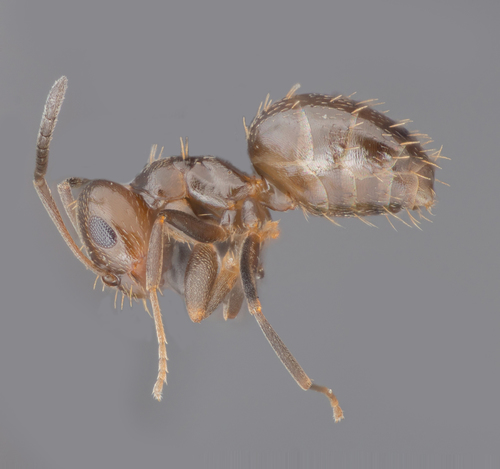
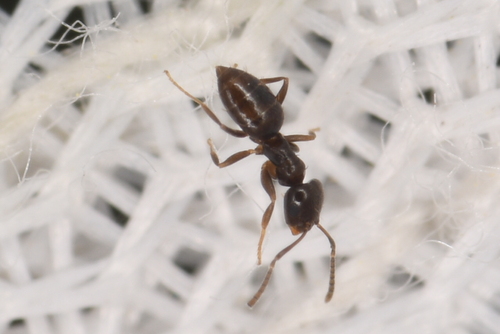
Dark rover ants are tiny brown workers 1 to 2 mm long, with queens about 3 mm, and they have long hairs on the mesosoma and relatively large eyes. They nest in soil, leaf litter, mulch, wood piles and man-made structures, and they are native to Argentina and Paraguay but have spread from New Orleans. They feed on nectar from extrafloral nectaries and can survive on a lab diet of honey solution, tuna, and caterpillar pieces.
Source: Wikipedia
How to recognize it
They are small brown ants under 2.5 mm with long hairs on the mesosoma and relatively large eyes.
Source: Wikipedia
Size
Workers range from 1.0 mm to 2.0 mm; queens are about 3.0 mm. Overall they are less than 2.5 mm long.
Source: Wikipedia
Is it a pest in the house?
They are considered a nuisance pest because they infest man-made structures.
Source: Wikipedia
Does it bite or sting?
They do not bite, sting, or transmit disease.
Source: Wikipedia
Where it lives
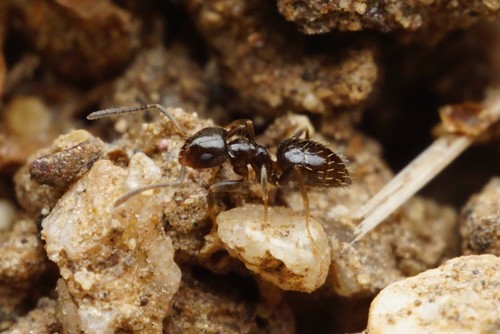
Colonies are found in soil, at tree bases, leaf litter, wood piles, trash piles, mulch and other man-made structures.
Source: Wikipedia
What it eats
In the wild they visit extrafloral nectaries for nectar. In the lab they accept a diet of 30 % honey solution, liquid tuna, and caterpillar pieces.
Source: Wikipedia
Life cycle
Like many invasive ants, they tend to be polygyne, spread by budding, and can form supercolonies with many queens. Each colony is a single nest that is genetically distinct from nearby colonies.
Source: Wikipedia
Where it comes from
Native to South America, especially Argentina and Paraguay. Likely introduced to the U.S. via New Orleans, a common entry point for tropical species.
Source: Wikipedia
Where it is found in the US
Recorded in 14 of 51 states and DC. Most records: Texas, California, Arizona, Mississippi, Florida, Louisiana, North Carolina, Alabama.
Darker = more records. Counts are museum and citizen-science records, not population size.
Source: GBIF
Status: introduced in United States. Source: iNaturalist
Months it is reported in the US
Source: GBIF
More photos
Questions people ask
Where might I find them in my yard?
Look in soil, leaf litter, mulch, wood piles, and around the bases of trees.
Source: Wikipedia
What do they eat?
They feed on nectar from extrafloral nectaries and can survive on sugary and protein-rich foods like honey, tuna, and small insects.
Source: Wikipedia
Same family (Formicidae)
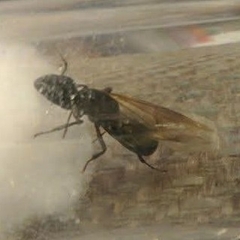 Eastern Black Carpenter AntCamponotus pennsylvanicusCan damage your home
 Red Imported Fire AntSolenopsis invictaCan sting
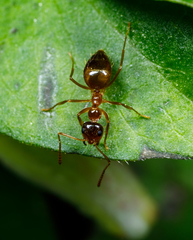 American Winter AntPrenolepis imparis
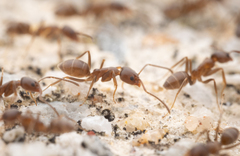 Argentine AntLinepithema humileNuisance, not dangerous
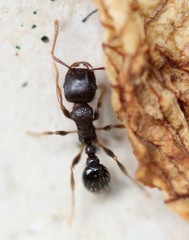 Immigrant Pavement AntTetramorium immigransCan sting
 Odorous House AntTapinoma sessileCan damage your home
Sources
- Wikipedia: https://en.wikipedia.org/wiki/Brachymyrmex_patagonicus
Look it up elsewhere: GBIF · iNaturalist · BugGuide · ITIS · Wikipedia
Text written 2026-10-22 from the sources above and checked sentence by sentence against them. Data fetched 2026-10-22.