 Bug FAQ
Dark Coprosma Carpet
Austrocidaria similata · Order: Lepidoptera · Family: Geometridae
Also called: Dark coprosma carpet moth, green and purple carpet moth

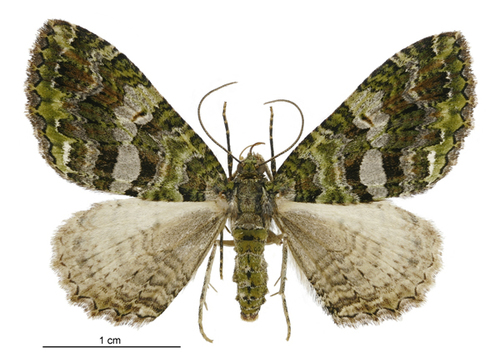
The Dark Coprosma Carpet moth has a wingspan of about 1¼ inches (about 3 cm). It lives in native forest and shrubland in New Zealand where its larvae feed on Coprosma plants. Adults can be seen all year, but are most common from October to March.
Source: Wikipedia
How to recognize it
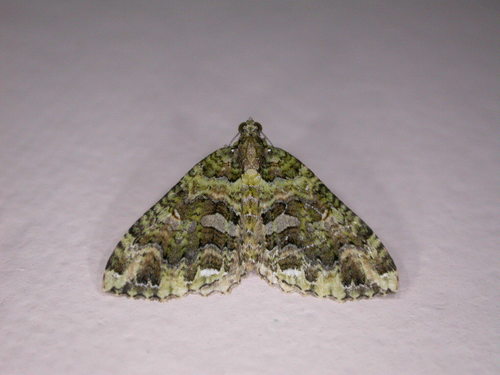
Fore-wings are dark grey-brown or purplish-brown with bright-green veins and margins, plus wavy blackish streaks that form three vague dark bands. A series of fine black marks runs along the wing edge and the fringe (cilia) is dark brown; hind-wings are cream-coloured with pale reddish-brown tinges and wavy pale brown lines. When at rest, two white oblong patches appear on the lower fore-wings near the abdomen.
Source: Wikipedia
Size
The wings measure about 1¼ inches across.
Source: Wikipedia
Where it lives
It inhabits native forest and shrubland where its host plants grow.
Source: Wikipedia
What it eats
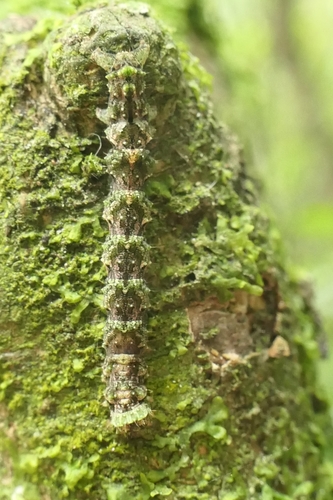
Larvae feed on plants of the genus Coprosma.
Source: Wikipedia
Life cycle
Eggs are white and oval and take about three weeks to develop. It is thought that the species overwinters as larvae. Larvae pupate on the ground inside a thin silk cocoon mixed with debris.
Source: Wikipedia
When you see it
Adults are on the wing throughout the year, with peak sightings from October to March.
Source: Wikipedia
Where it comes from
The species is endemic to New Zealand.
Source: Wikipedia
Lookalikes
It resembles A. callichlora but can be told apart by a purple-grey mark where the fore-wings meet and the two white patches on the lower fore-wings.
Source: Wikipedia
More photos
Same family (Geometridae)
 Willow BeautyPeribatodes rhomboidaria
 Pale BeautyCampaea perlataDamages trees, gardens or crops
 Large Lace-border MothScopula limboundataDamages trees, gardens or crops
 Riband WaveIdaea aversata
 Yellow Shell MothCamptogramma bilineata
 Large Maple Spanworm MothProchoerodes lineolaDamages trees, gardens or crops
Sources
- Wikipedia: https://en.wikipedia.org/wiki/Austrocidaria_similata
Look it up elsewhere: GBIF · iNaturalist · BugGuide · Wikipedia
Text written 2026-10-23 from the sources above and checked sentence by sentence against them. Data fetched 2026-10-22.