 Bug FAQ
Dark-barred Twin-spot Carpet
Xanthorhoe ferrugata · Order: Lepidoptera · Family: Geometridae
Also called: Red Twin-spot Carpet, Red Twin Spot, Red Twin-spot Carpet Moth, Red Twin-spot Moth
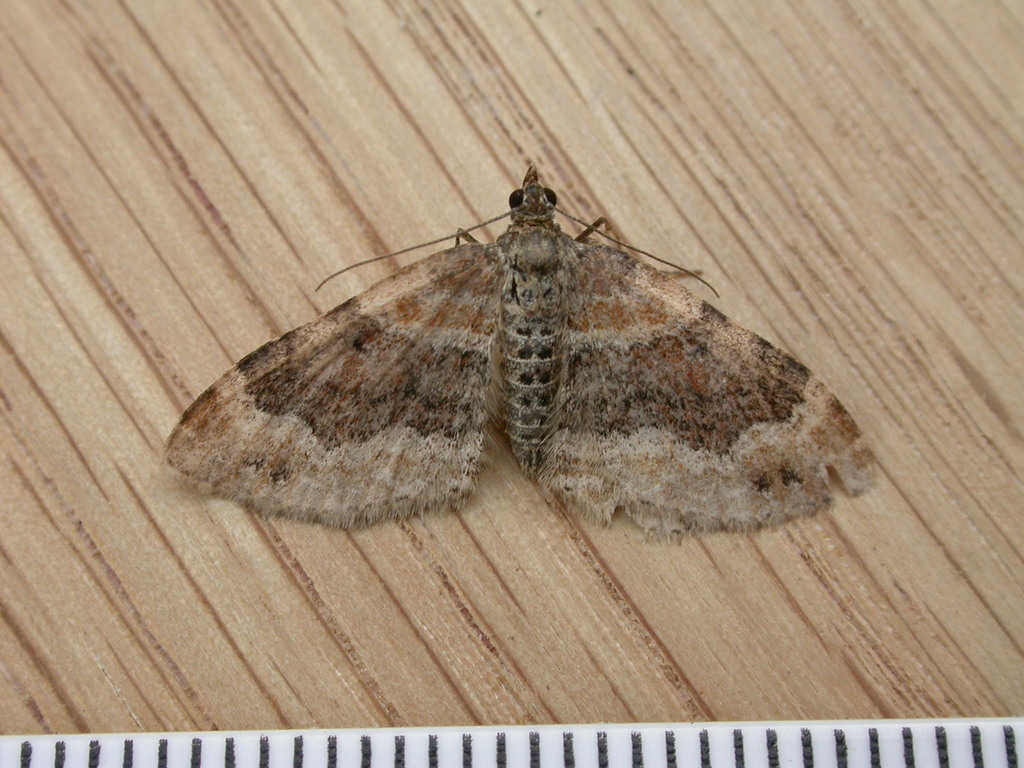
The Dark-barred Twin-spot Carpet has a reddish-purple median band and a mostly white distal area, though a common form called ab. unidentaria has a black median band. It occurs across Europe, Siberia, Tibet, China, the Caucasus, Turkey, and also throughout North America from Alaska to Newfoundland and down to North Carolina and California. The species was first described in 1759 and has a Holarctic distribution.
Source: Wikipedia
How to recognize it
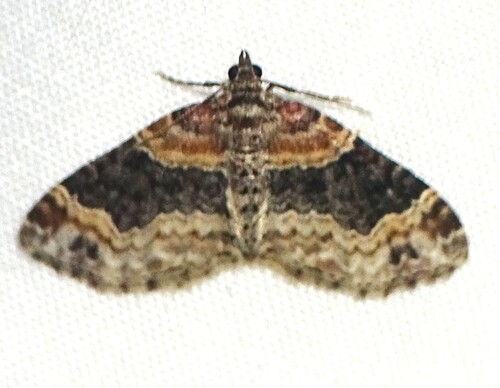
The typical form shows a reddish-purple median band with a weakly marked distal area that is often almost entirely white. The common aberration ab. unidentaria has a black median band instead of reddish.
Source: Wikipedia
What it eats
The caterpillars feed on Galium, Stellaria, Campanula and Cirsium species.
Source: Wikipedia
Life cycle
The first-generation larvae appear from August to September, the second-generation larvae from June to July, and the first-generation pupae overwinter.
Source: Wikipedia
Where it comes from
In North America it runs from Alaska to Newfoundland, south to North Carolina and California. First described by Clerck in 1759, it has a Holarctic distribution.
Source: Wikipedia
Lookalikes
It can be hard to separate from Xanthorhoe spadicearia and resembles X. biriviata and X. vidanoi.
Source: Wikipedia
Where it is found in the US
Recorded in 35 of 51 states and DC. Most records: Pennsylvania, Vermont, New York, Ohio, Michigan, Wisconsin, Massachusetts, West Virginia.
Darker = more records. Counts are museum and citizen-science records, not population size.
Source: GBIF
Status: native in North America; native in Canada; native in United States. Source: iNaturalist
Months it is reported in the US
Source: GBIF
More photos

Questions people ask
How can I tell this moth apart from similar species?
Look for the reddish-purple median band and mostly white distal area; the common ab. unidentaria form has a black median band, and it differs from X. spadicearia and related species.
Source: Wikipedia
Same family (Geometridae)
 Willow BeautyPeribatodes rhomboidaria
 Pale BeautyCampaea perlataDamages trees, gardens or crops
 Large Lace-border MothScopula limboundataDamages trees, gardens or crops
 Riband WaveIdaea aversata
 Yellow Shell MothCamptogramma bilineata
 Large Maple Spanworm MothProchoerodes lineolaDamages trees, gardens or crops
Sources
- Wikipedia: https://en.wikipedia.org/wiki/Xanthorhoe_ferrugata
Look it up elsewhere: GBIF · iNaturalist · BugGuide · ITIS · Wikipedia
Text written 2026-10-23 from the sources above and checked sentence by sentence against them. Data fetched 2026-10-22.