 Bug FAQ
Crusader Bug
Mictis profana · Order: Hemiptera · Family: Coreidae
Source: Wikipedia

They occur in most habitats except deserts and are native to Australia, Indonesia and the Indo-Pacific. They feed on many plants, including eucalypts, wattles, citrus, grape, tomato and beans, and can be a minor pest of citrus and wattles.
Source: Wikipedia
How to recognize it
Adults are stout, grey-brown to brown and have a clear cream or yellow saltire on the back. Later-instar nymphs show a pair of orange spots on the abdomen and orange-marked wing pads.
Source: Wikipedia
Size
Adults measure 20 to 25 mm in length and 7 to 10 mm in width.
Source: Wikipedia
Life cycle
In males the hind legs are shorter and markedly swollen.
Source: Wikipedia
Where it comes from
Their native range includes Australia, Indonesia and the Indo-Pacific region.
Source: Wikipedia
More photos


Questions people ask
What plants can Crusader Bugs damage?
They can damage citrus and wattles, and may also feed on grape, tomato and beans.
Source: Wikipedia
Where are Crusader Bugs found?
They occur in most habitats except deserts, from urban gardens to coastal heath.
Source: Wikipedia
Are they native to my area?
They are native to Australia, Indonesia and the Indo-Pacific region.
Source: Wikipedia
How can I recognize an adult Crusader Bug?
Adults are stout, grey-brown with a cream or yellow saltire on the back and measure about 20 to 25 mm long.
Source: Wikipedia
Same family (Coreidae)
 Western Conifer Seed BugLeptoglossus occidentalisDamages trees, gardens or crops
 Squash BugAnasa tristisDamages trees, gardens or crops
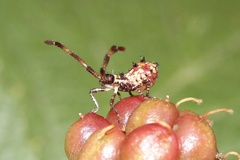 Dock BugCoreus marginatus
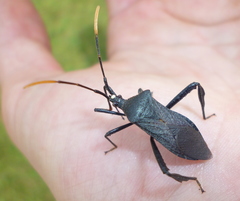 Acanthocephala terminalisAcanthocephala terminalisHarmless
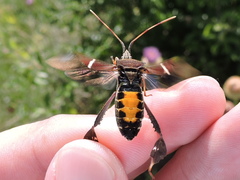 Eastern Leaf-footed BugLeptoglossus phyllopusDamages trees, gardens or crops
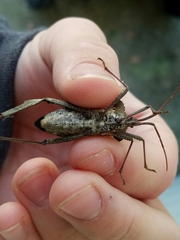 Giant leaf-footed bugAcanthocephala declivis
Sources
- Wikipedia: https://en.wikipedia.org/wiki/Mictis_profana
Look it up elsewhere: GBIF · iNaturalist · BugGuide · ITIS · Wikipedia
Text written 2026-10-23 from the sources above and checked sentence by sentence against them. Data fetched 2026-10-22.