 Bug FAQ
Cotton Bollworm Moth
Helicoverpa armigera · Order: Lepidoptera · Family: Noctuidae
Also called: African Bollworm Moth, Chickpea Pod Borer Moth, Corn Earworm Moth, Legume Pod Borer Moth
Source: Wikipedia
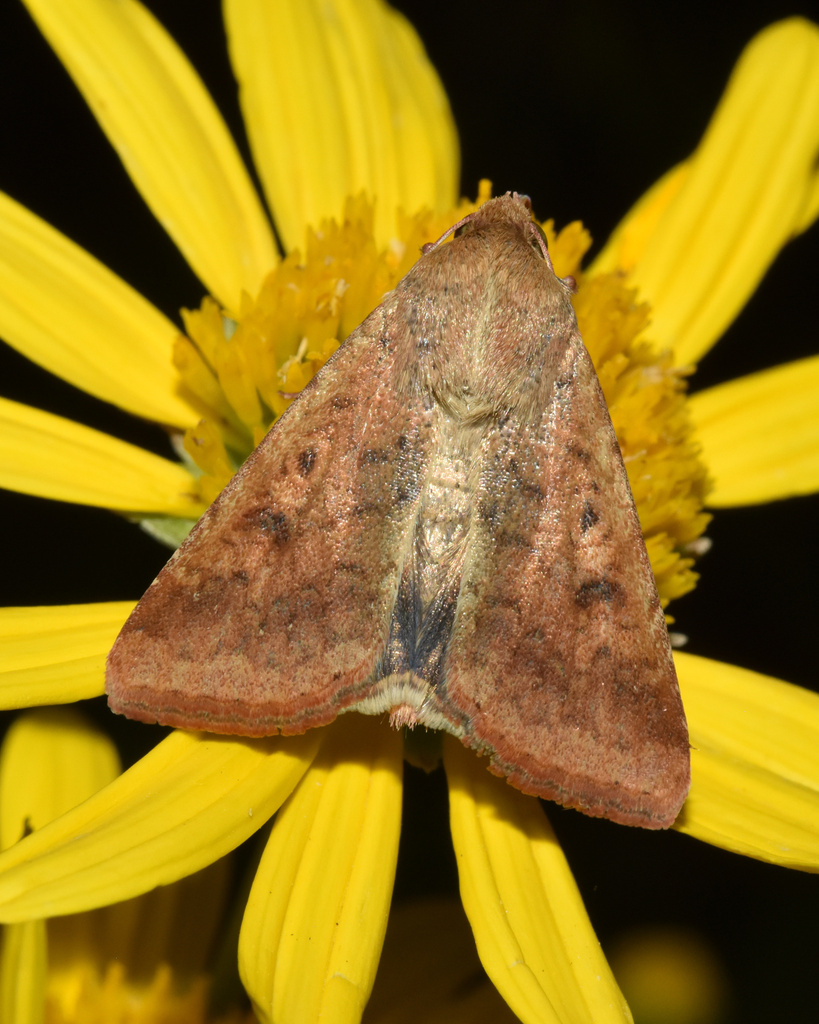
The cotton bollworm moth is a medium-sized moth with a 30 to 40 mm wingspan and body length of 12 to 20 mm. Its larvae feed on a wide range of important crops, especially cotton, tomato, chickpea and rice, causing major damage to agriculture.
Source: Wikipedia
How to recognize it
Females have yellow-orange forewings while males are greenish-gray, each with a darker band near the wing tip. The hindwings are pale yellow with a narrow brown edge band and a dark spot in the centre.
Source: Wikipedia
Size
Body length ranges from 12 to 20 mm and wingspan from 30 to 40 mm.
Source: Wikipedia
Is it a pest in the house?
Control methods include resistant varieties, cultural practices, insecticides and biological agents like Trichogramma spp. and Habrobracon hebetor.
Source: Wikipedia
How to get rid of it
Hand-picking and destroying eggs and young caterpillars can work in small plots. Light and pheromone traps are recommended to catch adult moths.
Source: Wikipedia
Where it lives
It is a major, highly polyphagous pest found worldwide in cotton fields and many other crops. Do not confuse it with the similarly named larva of Helicoverpa zea.
Source: Wikipedia
Life cycle
Eggs can hatch in about three days and the whole life cycle may finish in just over a month under good conditions. Larvae develop for 13 to 22 days, reaching up to 40 mm in the sixth instar.
Source: Wikipedia
When you see it
It is a migratory species that can reach northern areas such as Scandinavia.
Source: Wikipedia
Where it comes from
The subspecies H. a. conferta is native to Australia and Oceania.
Source: Wikipedia
Lookalikes
Do not mistake it for the similarly named larva of Helicoverpa zea.
Source: Wikipedia
Where it is found in the US
Recorded in 10 of 51 states and DC. Most records: New Mexico, Georgia, Pennsylvania, California, Florida, Illinois, Kansas, Michigan.
Darker = more records. Counts are museum and citizen-science records, not population size.
Source: GBIF
Months it is reported in the US
Source: GBIF
More photos


Questions people ask
What crops are most affected by cotton bollworm?
The most important crops damaged are cotton, tomato, pigeon pea, chickpea, rice, sorghum and cowpea.
Source: Wikipedia
How can I control cotton bollworm in my garden?
You can hand-pick eggs and young caterpillars, use light or pheromone traps, and apply recommended biological controls such as Trichogramma spp.
Source: Wikipedia
Same family (Noctuidae)
 Ipsilon Dart MothAgrotis ipsilonDamages trees, gardens or crops
 Fall Armyworm MothSpodoptera frugiperdaDamages trees, gardens or crops
 Army Cutworm MothEuxoa auxiliarisDamages trees, gardens or crops
 Large Yellow UnderwingNoctua pronubaDamages trees, gardens or crops
 Silver ΥAutographa gamma
 American DaggerAcronicta americanaCan irritate skin
Sources
- Wikipedia: https://en.wikipedia.org/wiki/Helicoverpa_armigera
Look it up elsewhere: GBIF · iNaturalist · BugGuide · Wikipedia
Text written 2026-10-22 from the sources above and checked sentence by sentence against them. Data fetched 2026-10-22.