 Bug FAQ
Coronet
Craniophora ligustri · Order: Lepidoptera · Family: Noctuidae
Also called: The Coronet
Source: Wikipedia
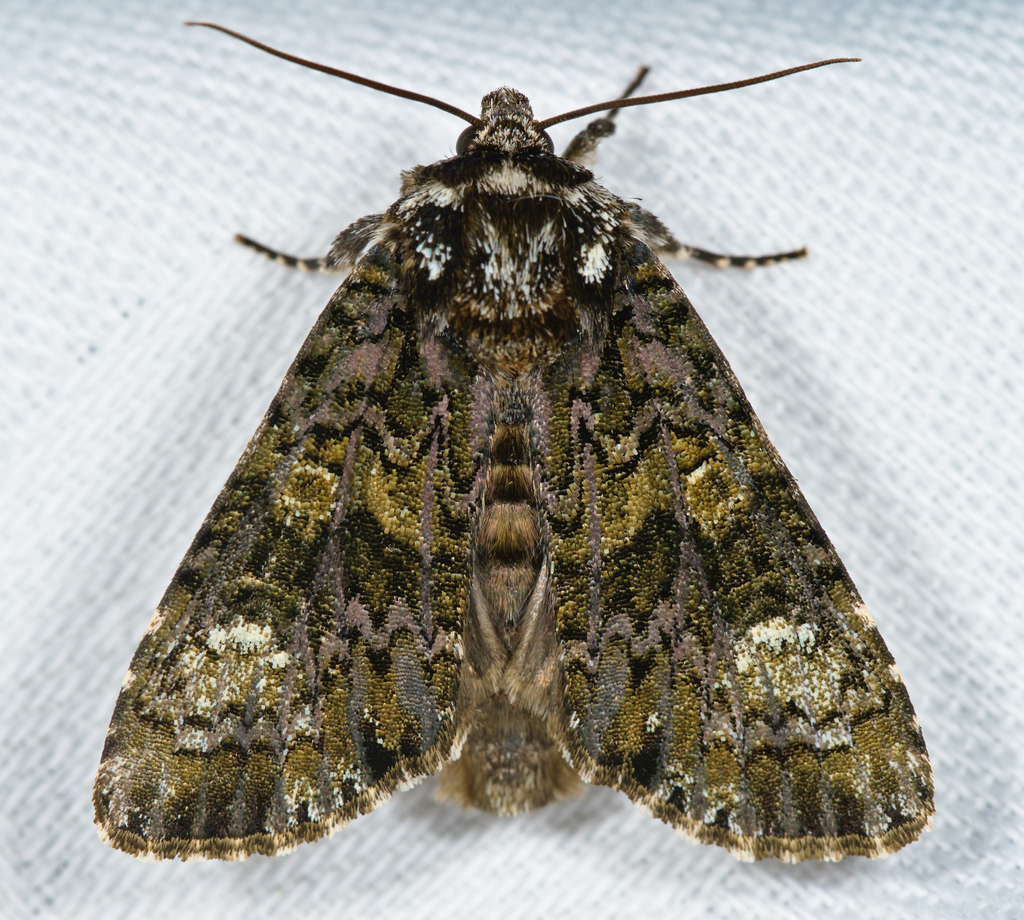
The coronet moth has a wingspan of about 30 to 35 mm and distinctive forewing markings that include a pale patch and a crown-like white spot. It lives across Europe and the Palearctic to Japan, flying from April to September depending on location. Caterpillars eat ash, common lilac and privet, which can affect those plants in gardens and woodlands.
Source: Wikipedia
How to recognize it
Forewings are purplish-brown with a greenish tint, a pale patch beyond the cell, and a white spot that looks like a crown.
Source: Wikipedia
Size
Wingspan ranges from 30 to 35 mm.
Source: Wikipedia
Where it lives
Found throughout Europe, the Palearctic region and into Japan. Adults are on the wing from April through September, varying by location.
Source: Wikipedia
What it eats
Caterpillars feed on ash (Fraxinus excelsior), common lilac and privet (Ligustrum vulgare).
Source: Wikipedia
Life cycle
The moth flies from April to September, timing depending on the region.
Source: Wikipedia
When you see it
Flight period is April to September, varying with location.
Source: Wikipedia
Where it comes from
In the north it reaches southern Scandinavia, the Baltic states, central Russia up to Saint Petersburg, and Ukraine.
Source: Wikipedia
Lookalikes
Form sundevalli has uniformly dark olive-green forewings and thorax. Form nigra is completely black on the forewing, found only in northern England; form coronula has a grey-brown suffused white apex with a white lunule on the inner edge.
Source: Wikipedia
More photos


Questions people ask
What plants do coronet moth caterpillars eat?
They feed on ash, common lilac and privet, which can damage those garden plants.
Source: Wikipedia
When can I see adult coronet moths?
Adults are active from April to September, depending on where you are.
Source: Wikipedia
Same family (Noctuidae)
 Ipsilon Dart MothAgrotis ipsilonDamages trees, gardens or crops
 Fall Armyworm MothSpodoptera frugiperdaDamages trees, gardens or crops
 Army Cutworm MothEuxoa auxiliarisDamages trees, gardens or crops
 Large Yellow UnderwingNoctua pronubaDamages trees, gardens or crops
 Silver ΥAutographa gamma
 American DaggerAcronicta americanaCan irritate skin
Sources
- Wikipedia: https://en.wikipedia.org/wiki/Craniophora_ligustri
Look it up elsewhere: GBIF · iNaturalist · BugGuide · Wikipedia
Text written 2026-10-22 from the sources above and checked sentence by sentence against them. Data fetched 2026-10-22.