 Bug FAQ
Common Heath
Ematurga atomaria · Order: Lepidoptera · Family: Geometridae
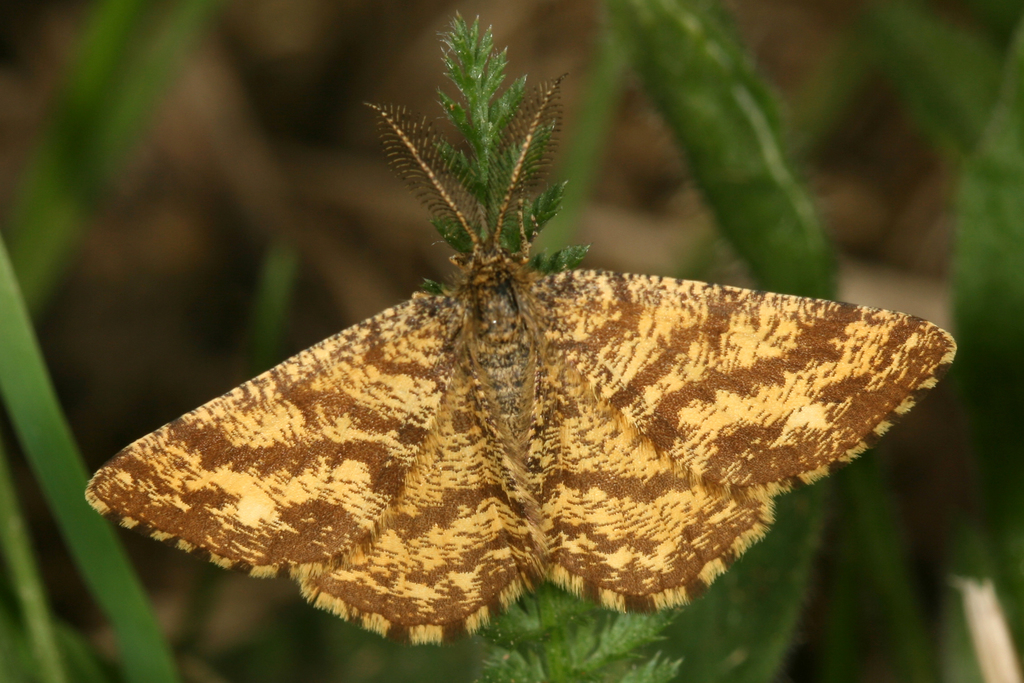
The common heath moth has a wingspan of about 2.4 to 3.4 cm and shows variable brownish colours with bands or spots. It is common on most heaths across the British Isles and flies mainly in May and June, sometimes again in August. Caterpillars feed on heather, heath, clover and related plants.
Source: Wikipedia
Size
The wingspan ranges from 24 to 34 mm (about 0.9 to 1.3 in).
Source: Wikipedia
What it eats
Caterpillars eat heather, heath, clover and related low plants, showing many colour forms from brown to greenish-brown, ochre, purple or grey.
Source: Wikipedia
Life cycle
In the British Isles the moth has one generation that flies from May to June; elsewhere a second generation may appear from June to September.
Source: Wikipedia
When you see it
Adults are on the wing in May and June, and occasionally some are seen in August.
Source: Wikipedia
Where it comes from
Its Palearctic range extends from the Iberian Peninsula across central and eastern Europe to Siberia and Sakhalin, and south to the northern Mediterranean and Turkish Black Sea coast.
Source: Wikipedia
Lookalikes
Some individuals closely resemble the moth Fidonia carbonaria and have been mistaken for it in the past.
Source: Wikipedia
Where it is found in the US
Recorded in 1 of 51 states and DC. Most records: Wisconsin.
Darker = more records. Counts are museum and citizen-science records, not population size.
Source: GBIF
Questions people ask
When can I see them?
Look for the adults in May and June, with occasional sightings in August.
Source: Wikipedia
Same family (Geometridae)
 Willow BeautyPeribatodes rhomboidaria
 Pale BeautyCampaea perlataDamages trees, gardens or crops
 Large Lace-border MothScopula limboundataDamages trees, gardens or crops
 Riband WaveIdaea aversata
 Yellow Shell MothCamptogramma bilineata
 Large Maple Spanworm MothProchoerodes lineolaDamages trees, gardens or crops
Sources
- Wikipedia: https://en.wikipedia.org/wiki/Ematurga_atomaria
Look it up elsewhere: GBIF · iNaturalist · BugGuide · Wikipedia
Text written 2026-10-22 from the sources above and checked sentence by sentence against them. Data fetched 2026-10-22.