 Bug FAQ
Common Groundhopper
Tetrix undulata · Order: Orthoptera · Family: Tetrigidae
Also called: Common Ground-hopper

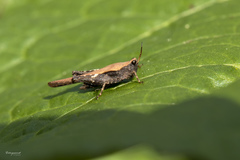
The common groundhopper is a tiny grasshopper about 6 to 12 mm long, with females a bit larger than males. Its colour ranges from dark brown to pale yellow-white, and lighter individuals often show a darker pattern. It lives on moist grasslands, meadows and marshes in Europe, but in dry places it stays in humid cool spots and in wet places it prefers drier microhabitats.
Source: Wikipedia
How to recognize it
Colour varies from dark brownish to light yellow-white, with lighter bugs usually bearing a darker pattern.
Source: Wikipedia
Size
Body length is between 6 and 12 mm, females being slightly larger than males.
Source: Wikipedia
Where it lives
Found mainly in moist grasslands such as meadows and marshes, but in dry areas it stays in humid, cooler spots, and in wet areas it seeks drier places.
Source: Wikipedia
What it eats
It feeds mainly on mosses and algae.
Source: Wikipedia
Life cycle
Development from egg to adult takes one or two years, with overwintering as nymphs or adults, and males and females mainly communicate by visual signals.
Source: Wikipedia
More photos


Questions people ask
How big are common groundhoppers?
They are 6 to 12 mm long, with females a little larger than males.
Source: Wikipedia
What do they look like?
Their colour ranges from dark brownish to pale yellow-white, and lighter individuals often have a darker pattern.
Source: Wikipedia
Where are they found?
They are widespread across Europe, from Spain and France to the Baltic states, Ukraine and western Russia.
Source: Wikipedia
Same family (Tetrigidae)


Sources
- Wikipedia: https://en.wikipedia.org/wiki/Tetrix_undulata
Look it up elsewhere: GBIF · iNaturalist · BugGuide · Wikipedia
Text written 2026-10-23 from the sources above and checked sentence by sentence against them. Data fetched 2026-10-22.